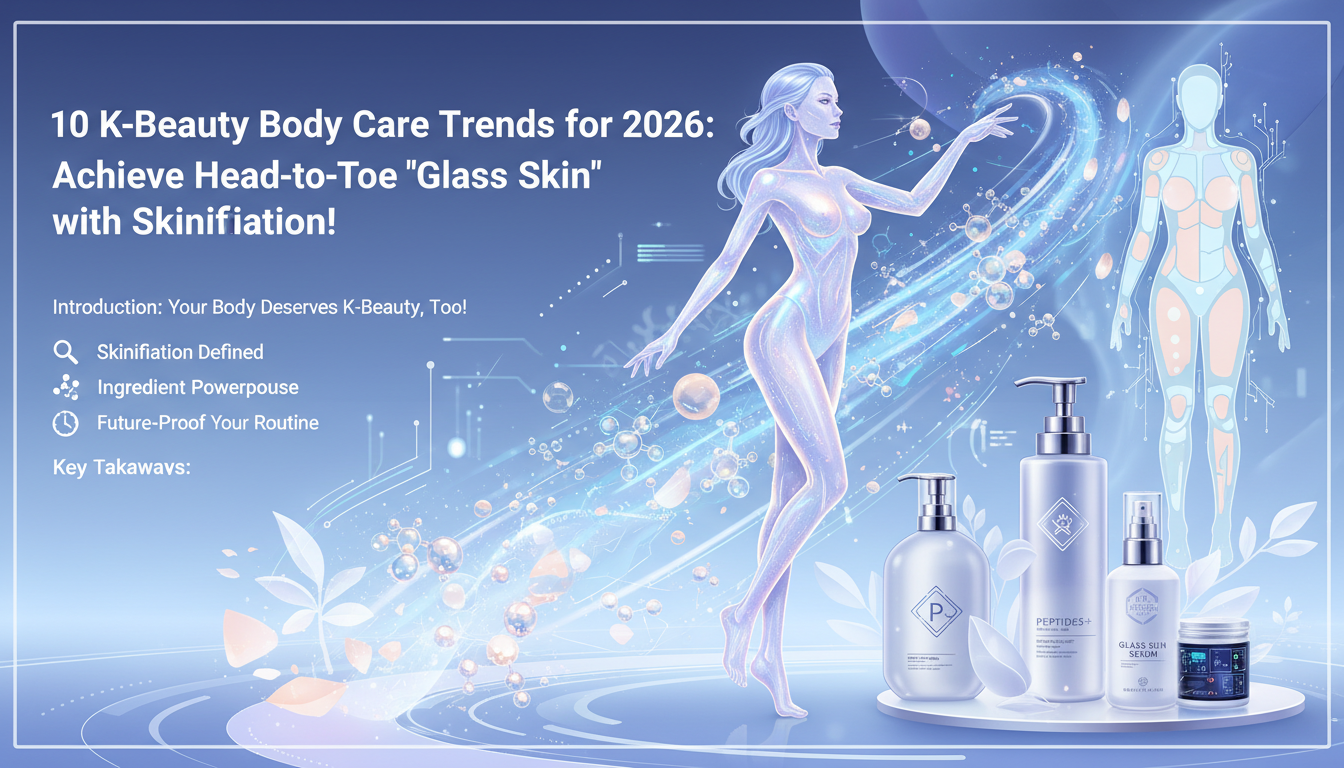
Your Body Deserves K-Beauty, Too!
Korean beauty has, for the better part of a decade, orchestrated a revolution in how we approach the skin on our faces. It has taught us discipline, ingredient literacy, and the art of the multi-step ritual. But a curious question has lingered in the background: where does the face end and the body begin? In 2026, this demarcation is dissolving. The game-changing trend of 'skinification' is set to transform K-Beauty body care, extending the sophisticated, results-driven philosophy from our jawlines down to our toes. It's a paradigm shift that invites us to reconsider the very canvas of our being and to pursue that coveted, luminous "glass skin" from head to toe.
Key Takeaways:
- Skinification Defined: Applying advanced facial skincare science and potent ingredients to the entire body for targeted results.
- Ingredient Powerhouse: Expect to see powerhouse ingredients like niacinamide, PDRN, peptides, and advanced exfoliants in your body lotions and serums.
- Future-Proof Your Routine: Learn about innovative trends, personalized tech, and ethical considerations shaping K-Beauty body care in 2026.
What is K-Beauty Body Care "Skinification"?
At its core, "skinification" is a rebellion against the historical neglect of body care. For too long, the category has been relegated to the simple, utilitarian act of moisturizing. Skinification reframes this, positing that the skin on our body is not a lesser entity but a continuum of the same vital organ we so meticulously treat on our face.
This "skin is skin" philosophy is built on several foundational principles. It demands the deployment of advanced, facial-grade ingredients. Think of the hyaluronic acid, niacinamide, and ceramides from your favorite face serum now formulated to treat your limbs. Peptides for firmness, gentle exfoliants like AHAs and PHAs for texture, and even emerging bio-actives like PDRN and bamboo extracts are migrating south.
This ingredient migration serves a higher purpose: targeted treatment. The movement looks beyond basic hydration to address specific concerns we once accepted as unchangeable—body acne, keratosis pilaris (KP), hyperpigmentation on the chest, or the premature textural changes on the neck and décolletage. It champions a holistic view of skin health, focusing on the long game of maintenance, protection, and regeneration. Finally, it normalizes routine-oriented care, encouraging multi-step regimens for the body, scalp, and even nails, mirroring the disciplined approach that defines K-Beauty facial care.
The Rise of Whole-Body Skincare
This paradigm shift is not arbitrary; it is the logical outcome of a confluence of cultural and market forces. The modern consumer is no longer a passive recipient of marketing but an active, informed participant in their own wellness. They arrive with evolved expectations, demanding tangible efficacy and visible results. They are fluent in the language of ingredients—retinol, squalane, collagen—and expect their body products to perform with the same clinical precision as their facial treatments, addressing everything from uneven tone to body acne.
Propelling this movement into the mainstream is the undeniable influence of social media. Platforms like TikTok and Instagram act as vast, decentralized classrooms and marketplaces of ideas. The #Skintok phenomenon and the ritualization of the "Everything Shower" broadcast the appeal of top-to-toe care to a global audience. Gen Z and Millennial consumers, in particular, are driving this demand, with a staggering 71% discovering new products through the unfiltered lens of user-generated content and influencer recommendations.
This groundswell of interest is reflected in a booming market. The global body care sector, valued at $22.3 billion, is exhibiting dynamic growth that outpaces the wider skincare industry. In Europe, sales of prestige body serums and oils have soared by 42% and 12%, respectively, in the last year alone. This is a testament to a market responding to demand with sophisticated innovation, from multi-benefit sunscreens to microbiome-balancing body washes. K-Beauty, having laid the groundwork by normalizing ingredient literacy and the aspirational goal of "glass skin," now finds its philosophy naturally extending across the entire body.
From Basic Lotion to Body Serums
The journey from a simple moisturizing lotion to a targeted body serum is more than a product evolution; it's an ideological one. Historically, body care was about palliative comfort—soothing dryness, providing a pleasant scent. Skinification marks a definitive transition from this simple hydration model to one of specialized, problem-solving formulations.
For K-Beauty, this feels like a natural progression. The relentless innovation that gave us essences, ampoules, and sleeping masks for the face has simply found new territory to conquer. The industry's philosophy of meticulous dedication is now being applied to the body, expanding the very definition of a comprehensive skincare routine. The aesthetic goal of "glass skin"—that smooth, luminous, almost translucent quality achieved through deep hydration and perfect texture—is no longer confined to the face. It has become a full-body aspiration. Central to this new chapter is the K-Beauty tenet of barrier care, as the understanding that a strong, resilient skin barrier is the foundation of health is now fully integrated into how we formulate for and treat the entire body.
Navigating Advanced Body Care
Yet, this relentless pursuit of perfection is not without its complexities. As we deploy increasingly potent actives over larger surface areas of the body, we must engage with a necessary counterpoint: the conversation around safety, moderation, and systemic effects.
The question of systemic absorption is paramount. Many topical ingredients, from heavy metals in certain colorants to chemical UV filters, can and do enter the bloodstream, where their long-term effects are still being studied. Preservatives like isothiazolinones and fragrance components like phthalates have been linked to allergic reactions and endocrine disruption. Perhaps most concerning is the "cocktail effect"—the unknown cumulative impact of dozens of chemicals applied daily across a suite of products.
Certain controversial ingredients warrant a particularly discerning eye. Retinoids, celebrated for their smoothing and firming prowess, come with the risk of irritation, sun sensitivity, and a debated potential for systemic Vitamin A toxicity, especially when combined with diet and supplements. This is why their use is cautioned against for pregnant or breastfeeding women. Similarly, hydroquinone, a powerful agent against hyperpigmentation, walks a fine line. While effective, it carries risks of irritation, ochronosis (a blue-black skin discoloration), and has faced regulatory scrutiny and bans in several regions due to safety concerns.
Even seemingly benign practices like exfoliation can be taken too far. The quest for smooth skin can lead to over-exfoliation, a state where the skin's protective barrier is compromised, resulting in redness, sensitivity, and even breakouts. In this new landscape, one must also be wary of misleading marketing and social media trends, where unscientific "hacks" and the promotion of at-home procedures by non-experts can lead to real harm. Navigating this new frontier requires not just enthusiasm, but wisdom.
2026 K-Beauty Body Care Forecast
The trajectory of K-Beauty body care points toward an exciting synthesis of biotechnology, personalization, and conscious consumption. The broader K-Beauty market, projected to hit USD 187.4 billion by 2030, will see body care as a significant engine of its growth.
The ingredient landscape will continue to evolve with next-level actives. We will see a rise in regenerative biotechnology, with ingredients like PDRN (a salmon DNA derivative) and exosomes being used for their profound cellular repair and collagen-boosting capabilities. Lab-grown botanicals will offer sustainable and highly potent versions of beloved extracts like ginseng and Centella. The focus on barrier health will culminate in advanced barrier-strengthening complexes that use precise blends of ceramides, lipids, peptides, and postbiotics.
Technology will offer unprecedented AI-powered personalization, with at-home skin scanners and smart devices analyzing the skin on our bodies to prescribe bespoke routines for hydration, pigmentation, or texture. This dovetails with the rise of At-Home Medical Beauty (M-Beauty), where clinic-grade treatments, post-procedure recovery serums, and micro-channeling tools are adapted for safe and effective home use.
Counterintuitively, this complexity will be balanced by a "skinimalist" ethos favouring hybrid formulations—smart, multi-tasking products that streamline routines without sacrificing efficacy. The user experience will also be paramount, with a focus on enhanced sensorial textures and cooling care formulations designed to instantly lower skin temperature and provide "redness relief." And underpinning all of this will be an unwavering commitment to sustainability and ethics, with refillable packaging, water-responsible manufacturing, and vegan formulations becoming industry standards rather than exceptions.
FAQ Section
Q1: What exactly is "skinification" in K-Beauty body care?
A1: Skinification is the trend of applying advanced skincare principles, potent ingredients, and multi-step routines, traditionally used for facial care, to the entire body. It aims to treat body skin with the same dedication to achieve targeted results and overall skin health.
Q2: Which K-Beauty ingredients are trending in body care for 2026?
A2: Expect to see ingredients like Niacinamide, Hyaluronic Acid, Ceramides, Peptides, Retinol, AHAs (Alpha Hydroxy Acids) and PHAs (Poly Hydroxy Acids) for exfoliation, and innovative ingredients such as PDRN (Polydeoxyribonucleotide), Centella Asiatica (Cica), and bamboo extracts.
Q3: Are there any risks or controversies associated with using advanced ingredients in body care?
A3: Yes, some advanced ingredients, like retinol or hydroquinone, can cause irritation, increase sun sensitivity, or have systemic absorption concerns. Over-exfoliation can also damage the skin barrier. Always start with low concentrations, use sunscreen, and consult a dermatologist if you have concerns or sensitive skin.
Q4: How does K-Beauty body care emphasize a holistic approach?
A4: K-Beauty body care encourages viewing skin as a vital organ requiring consistent care for overall wellness. It integrates self-care rituals, mood-enhancing formulations, and a focus on strengthening the skin barrier to protect against environmental aggressors and maintain long-term skin health.
Embrace the Future of K-Beauty Body Care!
The 'skinification' of K-Beauty body care is far more than a fleeting trend; it is a profound and welcome correction in our approach to self-care. It represents a collective recognition that the skin is a seamless organ deserving of intelligent, thoughtful, and effective treatment in its entirety. As we move through 2026, the opportunity to elevate our routines with cutting-edge science, personalized technology, and a truly holistic philosophy is here. The pursuit of that coveted "glass skin" is no longer a localized ambition but a head-to-toe reality.


