When Grandmas Go Gorpcore and AI Designs Your Next OOTD
One could be forgiven for thinking they understand K-Fashion. The mind conjures images of meticulously coordinated K-Pop stage outfits, the effortless chic of K-Drama protagonists, a certain polished yet accessible street style that has captured the global imagination. But to hold that image static is to miss the point entirely. The narrative for 2026 is one of delicious paradox, a "soft clash" of ideologies where contradictions are not to be resolved, but embraced. We are entering a period of "Refined Clarity," an aesthetic movement that finds its footing in the tension between high-tech futurism and cozy, handcrafted nostalgia, between architectural minimalism and a joyous, playful maximalism.
The Hallyu wave, with its idol and actor ambassadors, remains the powerful vessel carrying these ideas to international shores. Yet, the message it carries is shifting. The focus is tilting away from a singular, replicable "look" towards a more nuanced, deeply personal articulation of style. K-Fashion is no longer just a trend to be followed; it's a conversation to be had.
From Hanbok to Hallyu: A Quick K-Fashion History Lesson
To understand where a culture is going, one must first appreciate from whence it came. The story of Korean fashion does not begin in the bustling design studios of Gangnam, but in the elegant folds of the Hanbok. During the Joseon period, this traditional garment was not ceremonial attire but a daily statement—a canvas of vibrant color and comfortable, flowing lines that spoke to a distinct national aesthetic.
This sartorial continuity was, however, not uninterrupted. The 20th century brought with it the whispers of Western tailoring, followed by the harsh realities of Japanese occupation, which saw a pragmatic shift away from traditional dress. In the aftermath of the Korean War, a new creative energy emerged. Pioneers like Nora Noh, the nation's first contemporary fashion designer, became architects of a new Korean modernity, introducing the miniskirt and a sense of sartorial liberation to a generation eager to rebuild.
But it was the subsequent decades that truly forged the individualistic spirit we see today. The punk-inflected rebellion of the 70s and 80s, the embrace of denim's casual cool, and then, the cataclysmic event of the 90s: the rise of Hallyu. With the debut of groups like Seo Taiji and The Boys, music and fashion became inextricably linked. Style became a fierce declaration of self, a visual language as potent as any lyric, launching K-Fashion onto the global stage not as a follower, but as a formidable force of expression.
The Lookbook for 2026: What's Hot and What's Not-So-Not-Hot
The coming year’s aesthetic is less a set of rules and more a collection of fascinating philosophical inquiries, worn on the sleeve.
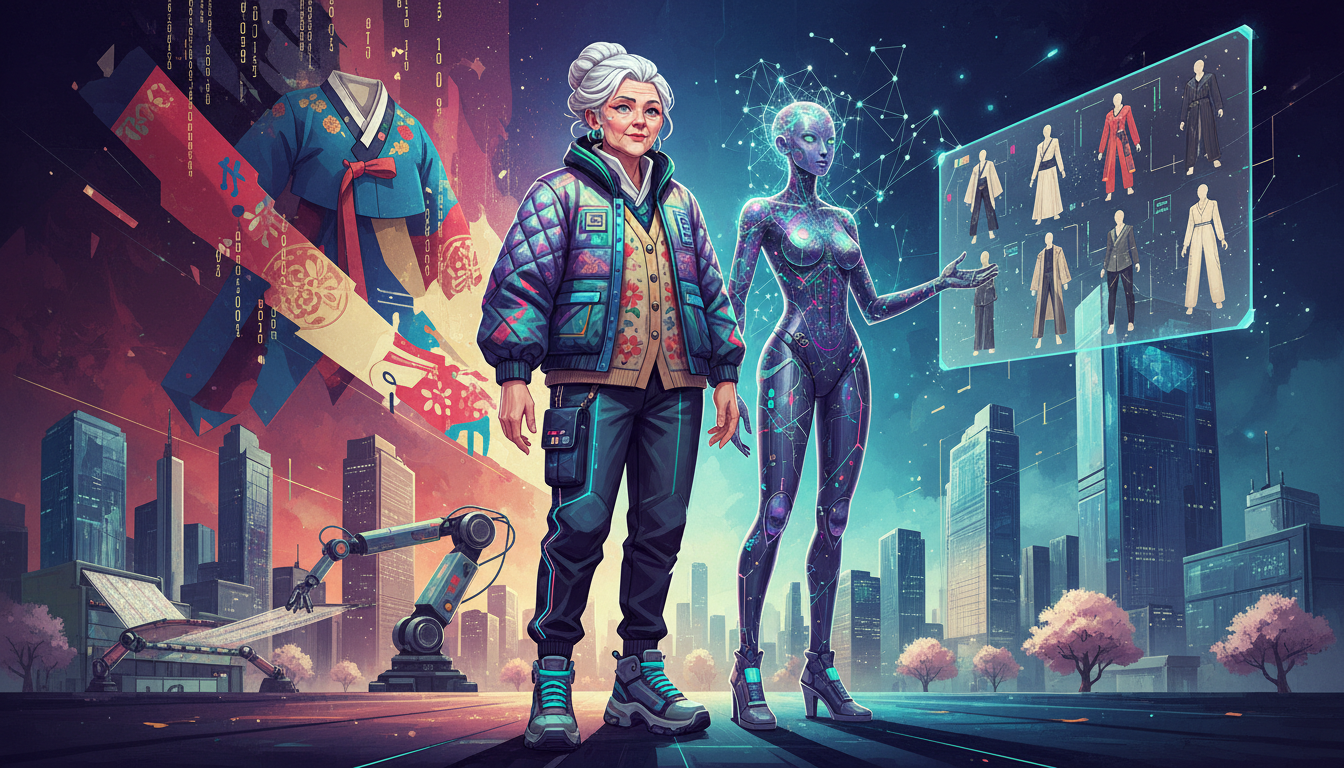
- The "Soft Clash" & "Editorial Realism": At the heart of the 2026 ethos is a beautiful friction. Imagine a sleek, futuristic tech-wear jacket layered over a quilted floral vest that feels plucked from a grandmother's closet. This is fashion that dreams but keeps its feet on the ground—aspirational yet profoundly wearable. It is an acknowledgment of our dual existence, lived both online in curated perfection and offline in tangible, messy reality.
- Minimalism's Modern Makeover vs. Maxed-Out Fun: The aesthetic landscape is bifurcated. On one path, we find the quiet confidence of clean, architectural silhouettes and sophisticated lines. On the other, a joyful cacophony of "jewelry overload," bold graphic prints, and an unapologetic embrace of the extra. These are not opposing teams, but two distinct answers to the question of self-expression: one finds poetry in restraint, the other in exuberant declaration.
- "Halmaenial" is the New Cool (Grannycore 2.0): This charming portmanteau of halmeoni (grandmother) and millennial points to a deeper cultural current. It is a turn towards the handcrafted and the inherited—delicate hand-stitching, lace collars on unexpected garments, a vintage brooch a grandmother might have owned. It manifests as a chic, almost academic aesthetic, a sartorial hug in an age of digital coldness.
- Technical Luxury & Gorp Core 3.0: Performance-wear continues its ascent from the mountains to the runways, but with a decidedly luxurious bent. We’re seeing seamlessly integrated wearable tech, 3D-printed structural elements on outerwear, and innovative, almost "paperweight" fabrics. Function is the new form, and the height of luxury is a garment that is both beautiful and brilliantly engineered.
- Denim Gets Disciplined: The era of contrived destruction appears to be waning. In its place, 2026 offers denim as a medium for precision. Clean, sharp lines, reinforced seams, and a focus on structural integrity are paramount. Even the returning low-slung, belted skirt is rendered with a new, polished intentionality.
- Lace, Corsets, and Androgynous Allure: A fascinating interplay of texture and form is at work. Lace appears, but in a sophisticated, almost "camouflagey" manner, sometimes given an edgy counterpoint with latex. The corset, a historically fraught garment, is predicted to become a mainstream staple, raising questions about reclamation and modern interpretations of structure. This exists alongside a growing and powerful movement towards genderless and androgynous styles, untethering fashion from binary constraints.
- Voluminous Silhouettes & Hyperreal Beauty: In a rebellion against the understated, expect dramatic shapes that command attention: voluminous skirts, exaggerated wide shoulders, and poetic balloon sleeves. This play on proportion extends to beauty, where "glass hair" and "jelly beauty"—think rubberized nails and impossibly bouncy lip gloss—create an intensely glossy, almost liquid-like finish that pushes reality into the uncanny valley.
Glimpses into Tomorrow: What's Next for K-Fashion
The future is arriving at an accelerated pace, propelled by technology, generational shifts, and global imperatives.
- The Tech Takeover (Seriously!): The fusion of fashion and technology is set to deepen. AI is poised to shorten design periods by over 80%, with industry associations planning to integrate it across the entire supply chain. Expect smart textiles and next-gen electronic fabrics to become commonplace. Government initiatives are pouring funds into developing eco-smart materials—recycled, biodegradable, and even plant-based vegan leathers—alongside innovations like waterless dyeing, with ambitious goals set for 2026-2030.
- Gen Z/MZ: The New Fashion Architects: The younger generations are not merely consumers; they are "cultural protagonists" actively shaping the market. They are the driving force behind the demand for "subtle luxury," verifiable sustainability, and radical individuality. Their preference for unique, platform-based labels over monolithic department store brands is fundamentally altering the retail landscape and fueling the boom in the second-hand luxury market.
- Global Domination (and Green Ambitions): The South Korean government has officially designated K-Fashion as a strategic export industry, providing institutional backing for its global expansion into key markets. Simultaneously, this ambition is tempered and shaped by global realities. The climate crisis and tightening regulations from bodies like the EU are pushing the industry towards a new paradigm of "season-less," "multi-functional," and truly sustainable design.
K-Fashion's Ever-Evolving Narrative
To look at South Korean fashion in 2026 is to witness a culture in dynamic conversation with itself. It is a dialogue between reverence for history and an insatiable appetite for innovation, between a powerful global influence and a critical self-reflection on its impact. It is a space where a grandmother’s quilting technique can coexist with an AI-generated design, where high-performance outerwear is a luxury good, and where sustainability is becoming as crucial as style.
K-Fashion, in its most compelling form, is not about the clothes themselves, but what they represent: a culture constantly reinventing, challenging, and redefining what it means to be modern in an increasingly complex world. It is a story still being written, and we would be wise to keep reading.


