
When I was a boy in 1980s of KOREA, I could tell you exactly what month it was with my eyes closed. Not by the calendar—by the air itself. The dry, razor-sharp cold of January that stung the inside of your nostrils. The sudden sweetness of April, when the wind carried cherry blossoms sideways through the streets like pink confetti. The crushing, sweat-soaked heat of August that made your shirt stick to your back before you even reached the bus stop. The clean, golden stillness of October, when the mountains surrounding Seoul turned into giant oil paintings overnight. Korea didn't just have four seasons. Korea performed them.
And now, standing here in what should be the middle of spring, wearing a winter coat one day and a T-shirt the next, I feel something I never expected to feel about weather: grief.
For Those Who Have Never Visited
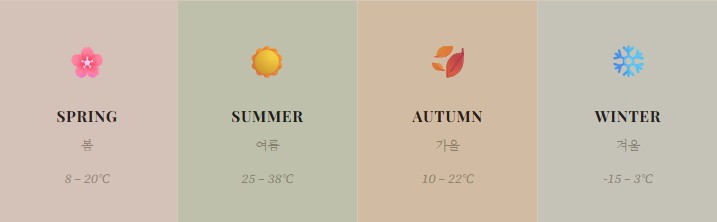
If you have never set foot in South Korea, let me explain something that surprises almost every first-time visitor. Korea is a place of astonishing extremes. In January and February, temperatures in Seoul routinely plunge to minus 10°C (14°F), sometimes lower—minus 15, minus 18. The kind of cold where exposed skin hurts within minutes, where puddles freeze into solid sheets overnight and your car windshield is caked in frost so thick you need ten minutes and a kettle of warm water just to see through it. You walk outside and the air feels like it has teeth.
Then, only a few months later, the same city hits 35°C (95°F) in August, sometimes pushing past 37 or 38. The humidity is staggering—tropical, almost violent. You step out of an air-conditioned convenience store and your glasses fog up instantly. The monsoon rains, called jangma (장마), dump weeks of relentless downpour on the peninsula. Streets flood. Umbrellas become useless props.
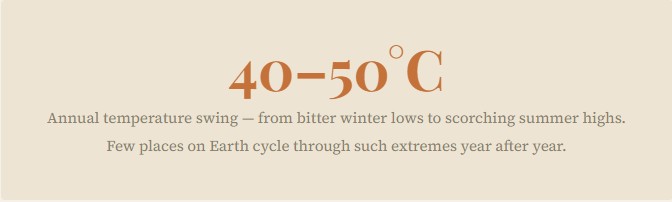
Think about that for a moment. The same small peninsula, roughly the size of Indiana or Portugal, swings through an annual temperature range of 40 to 50 degrees Celsius. From frozen rivers to tropical monsoons. From breath that crystallizes mid-air to sweat that never quite dries. Very few places on Earth put the human body through such a dramatic seasonal cycle, and Koreans have lived this way for thousands of years.
And here is a personal theory of mine—one that no dermatologist has confirmed, but one that I hold with quiet conviction. People around the world often remark on how clear and youthful Korean skin tends to look. The global beauty industry has spent billions trying to reverse-engineer "the Korean skincare secret." Endless serums, ten-step routines, snail mucin, fermented essences. And yes, Korean skincare culture is real and meticulous. But I sometimes wonder if the deeper secret isn't a product at all. I wonder if it is the seasons themselves.
Think about it: Korean skin has been trained, generation after generation, to survive enormous stress. The brutal dry cold of winter strips moisture away. The intense humidity of summer pushes the skin's oil production into overdrive. Then autumn dries everything out again, and spring brings yellow dust from China that coats every surface. Korean skin has had to adapt, to repair, to regenerate—constantly. Perhaps, over centuries, this relentless environmental pressure gave Korean skin a kind of resilience, a cellular memory of how to recover and renew. The skincare routine may simply be the culture catching up to what the climate already demanded. It's just my speculation, of course—but as a man in his late forties whose face has weathered every one of those seasons, I like to think there is something to it.
The Seasons I Carry Inside Me
Every Korean of my generation carries a private calendar of seasonal memories. Spring was not just a temperature—it was the smell of jeon (Korean pancakes) frying in oil on a rainy afternoon, your mother at the stove, the sound of rain hitting the vinyl awning outside. Spring was the annual school picnic to Namsan Mountain, all of us in matching tracksuits, passing boiled eggs wrapped in newspaper.
Summer was watermelon split open on the floor of your grandmother's apartment, seeds everywhere, electric fans oscillating in slow arcs while the adults napped. It was catching beetles near the stream, shirts soaked, knees muddy. It was the particular misery and joy of sambok—the hottest days of the lunar calendar—when the whole family would eat boiling-hot chicken soup, samgyetang, as if fighting heat with heat.
Autumn was the most beautiful word in the Korean emotional vocabulary. Gasuel (가을). Just two syllables, but they contain entire landscapes: crimson maple leaves against temple walls, the sound of roasting sweet potatoes from a cart on a side street, the first time you zipped your jacket and felt the cool air press against your neck like a gentle hand. Autumn in Korea didn't arrive—it descended, like a held breath finally released.
And winter. Winter was not something Koreans endured—it was something we inhabited. The ondol floor heating in old houses, where the warmest spot on the floor became contested family territory. The smell of roasted chestnuts. The particular silence of a heavy snowfall in a Seoul alley, where every sound softened. My father, standing in the courtyard at dawn, breath rising in clouds, hands wrapped around a cup of barley tea.
Each season had a beginning, a middle, and an end. Each one arrived on time, stayed long enough to be loved, and left gracefully enough to be missed. That was Korea.
What Is Happening Now
I don't know exactly when I first noticed. Maybe five or six years ago. Spring started arriving late—and then not really arriving at all. One week it was winter. Then, almost overnight, it was summer. The cherry blossoms came and went in three days instead of two weeks. There was no time to notice them, let alone sit beneath them.
Autumn has suffered even more. October used to feel like a month-long poem. Now it passes in a confused blur—warm one week, freezing the next. The foliage season on the mountains has shortened dramatically. Some years the leaves barely have time to turn before a sudden cold snap drops them all at once, like nature rushing through the final act.
The data confirms what my body already knows. Climate researchers report that Korea's spring and autumn periods have shrunk significantly over the past three decades, while summer has expanded by several weeks. Winters are becoming shorter but more erratic—warmer on average, but punctuated by sudden, violent cold snaps. The four-season rhythm that defined Korean life for millennia is collapsing into something simpler, harsher, and less beautiful: a long, punishing summer and a jagged, unpredictable winter, with two brief, confused transition periods in between.
Korea is becoming a two-season country. And nobody asked for this.
A Grief without a Name
There is no Korean word—at least not yet—for the specific sadness of watching your country's seasons dissolve. But I feel it on mornings like this one, when April feels like June, when I reach for a jacket and then put it back. It is not the dramatic grief of a sudden loss. It is the slow, quiet grief of erosion. Of something precious being rubbed away so gradually that by the time you notice, much of it is already gone.
My children will never know the Korea I grew up in. They will never understand what it meant to wait for autumn—truly wait for it, the way you wait for someone you love to come home. They will never feel that first cold morning of winter as a kind of arrival rather than an inconvenience. They will scroll through filtered photos of maple leaves on their phones and think they understand gasuel, but they will not have lived inside it the way my generation did.
I know this is not unique to Korea. The whole world is losing something. But Korea's four seasons were not just weather—they were the organizing principle of an entire culture. Our food, our holidays, our poetry, our clothing, our sense of time itself. The seasons were not backdrop. They were the story.
And the story is changing. Faster than we ever imagined. In a direction no one chose.
I still step outside every morning and check the air. I still close my eyes and try to guess the month by the temperature on my skin, the way I did as a boy. Most days now, I guess wrong.
But I keep trying. Because somewhere inside me, the four-season country is still there—vivid, distinct, and stubbornly, achingly alive.
'Korea Watch' 카테고리의 다른 글
| A Steaming Bowl of Home: Why Gukbap Is the Soul Food of Korea (0) | 2026.04.09 |
|---|---|
| Beyond Fine Dining:The K-Chef Wave You Didn't See Coming (0) | 2026.04.08 |
| [SEOUL VIBE] 2026 S/S: High-Tech Meets High-Nature in Korea! (0) | 2026.03.11 |
| Deregulation of Dawn Delivery: A Structural Shift in Korea’s Retail Landscape (1) | 2026.02.09 |
| Samsung’s HBM4 Power Play: Why Feb 2026 is the "D-Day" (0) | 2026.02.08 |


