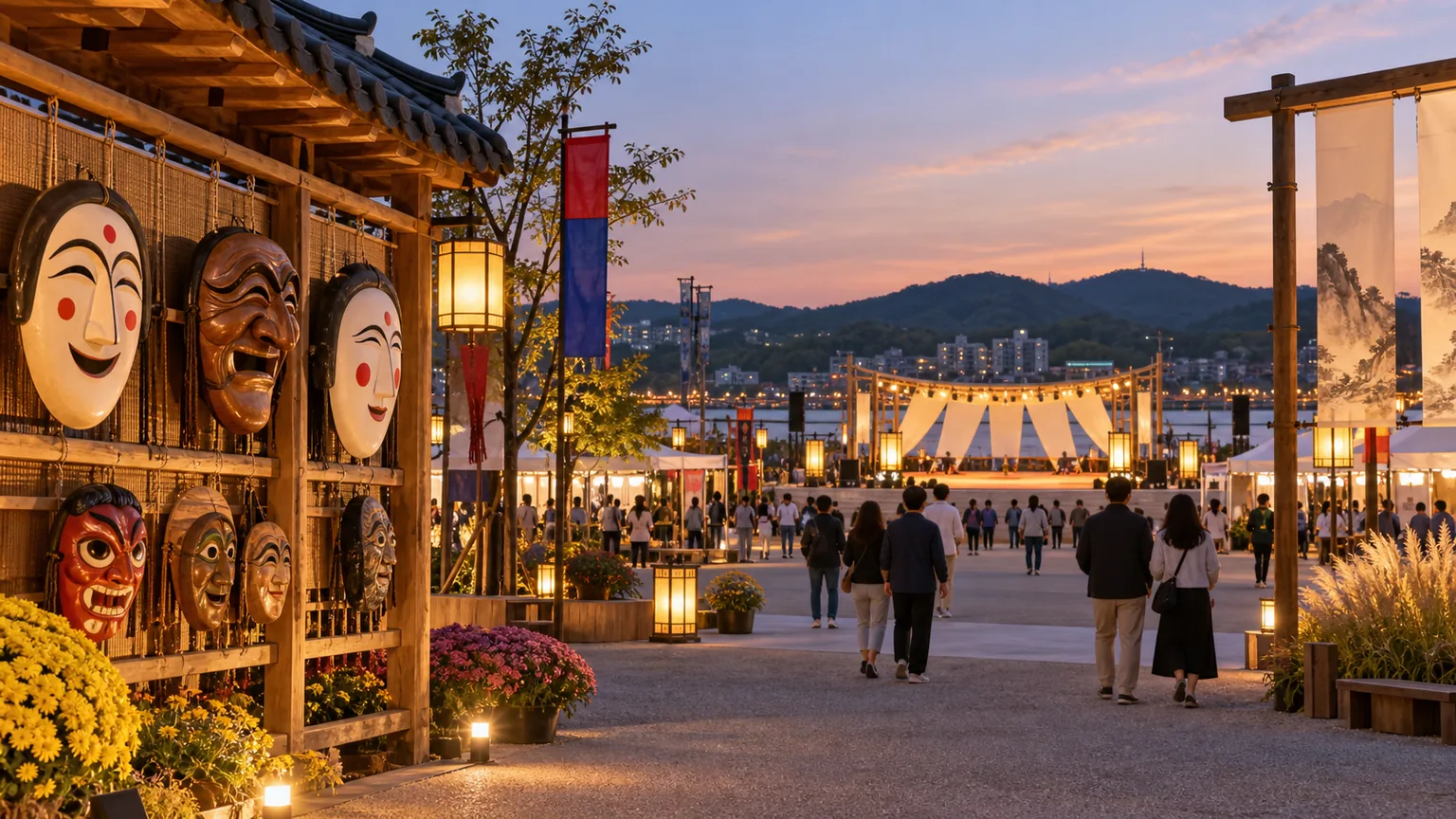
The Andong Maskdance Festival runs from September 24 to October 4, 2026, but the best day to attend depends on what you want from it. A visitor looking for a broad downtown festival can choose from the main program period. Someone who wants Hahoe Village, a night parade, a temple route, or a food-linked downtown pass should begin with the special-tour calendar instead. The dates are the easy part; matching the day to the experience is the real planning work.
The festival’s official English overview places programming around the Central Line 1942 Andong Station, Andong downtown, and Talchum Park. “Talchum” (탈춤) means mask dance, and it is the festival’s organising idea rather than a single stage show. The program brings Korean and international mask-dance traditions into the same city-wide event. That breadth is appealing, but it also means an itinerary based only on an opening date can be unfocused.
Start with the choice between open festival time and a tour
The main festival is the better fit when you want room to follow the public atmosphere: performances, city-center activity, and the chance to move between the station area, downtown, and Talchum Park. The Korea Tourism Organization’s festival listing describes Korean and international mask dances during the event and notes that program fees vary. In other words, broad festival access and individual paid experiences can coexist. Do not assume that one ticket category covers every activity.
The special tours are aimed specifically at international tourists and foreign residents. Their value is not simply transport. Each one groups a location, a festival moment, and a date. That gives a visitor a clearer answer to a common problem: how to reach a particular Andong experience without turning a short trip into a sequence of separate local bookings.
There is a trade-off. A tour fixes your day more tightly and requires enough participants to run. The official special-tour page says that a minimum of ten people is required and that schedules and fees may change. A self-directed festival day has more flexibility, yet it asks you to make more transport and timing decisions yourself. Neither is inherently better. The right option depends on whether the named destination is the reason for the trip.
The five special-tour choices
The official English special-tour page lists five 2026 routes. This is the comparison that matters most, because the locations and dates are not interchangeable.
| Route | Dates shown by the festival | Listed fee | Choose it when |
|---|---|---|---|
| Hahoe Village Seonyu Julbulnori Premium Tour | September 26; October 3 and 4 | US$27 per person | Hahoe Village and the evening Seonyu Julbulnori program are your priority |
| Hahoe Mission Tour and Night Parade | September 25 and 27 | US$20 per person | You want Hahoe Village paired with a night-parade experience |
| Manhyujeong and Woryeonggyo Pass | September 29 and October 1 | US$20 per person | You want a route built around those two Andong sights |
| Dosan Seowon and Bongjeongsa Pass | September 28, 30, and October 2 | US$20 per person | You want a Confucian academy and temple-focused day |
| 2026 Downtown Tour Pass | September 25 to October 4, on site | Purchase a meal voucher at a participating restaurant | You are already downtown and want a food-linked festival benefit |
The table makes one point plain: Hahoe is not a generic add-on. It has two different routes, and their dates do not overlap completely. The premium tour is the route to consider if Seonyu Julbulnori is the anchor. The Mission Tour is the more direct fit for someone who values the night parade. If you book the wrong date because both routes say “Hahoe,” you may arrive in Andong for a different program from the one you pictured.
Build the day around the place, then add the festival
Hahoe Folk Village (하회마을, Hahoe Maeul) is a meaningful choice for readers who want the festival to connect with a well-known historic village rather than stay entirely in the urban event zone. The official program gives its own specific nights to the village. That is a useful planning clue: choose Hahoe first, then let the tour date determine the rest of the day. Trying to squeeze it into an otherwise random festival visit risks spending most of the day on transfers.
Manhyujeong and Woryeonggyo form a different kind of route. The special tour pairs them on September 29 and October 1, so it suits visitors who want scenery and landmarks arranged as a single excursion. Dosan Seowon and Bongjeongsa, offered on September 28, 30, and October 2, belong to a more historical and architectural day. A seowon is a Neo-Confucian academy; a temple visit calls for a different pace from a late-evening parade. The tour names themselves are therefore the most reliable way to choose between these days.
The Downtown Tour Pass is the flexible option. According to the festival, a meal voucher at a participating downtown restaurant gives access to a special experience and one festival performance ticket. It is on-site from September 25 through October 4. This is the best fit for a visitor who arrives in town without committing to a full-day excursion and wants their meal to connect directly to the event. Ask the participating restaurant or the official festival desk what the current experience and performance options are when you arrive.
Use Andong Station as the practical anchor
The festival’s official overview identifies Central Line 1942 Andong Station as one of the core locations, alongside downtown and Talchum Park. That makes the station area a sensible arrival point for a day built around public programming. It also gives first-time visitors an easy Korean phrase to recognise: 안동역, Andong-yeok, means Andong Station. Save it in Korean on your phone if you expect to ask for directions.
From there, separate your plan into two layers. First, put the non-negotiable item on the calendar: an official special tour, a particular parade night, or an unstructured downtown festival day. Second, leave your secondary activities close to the station, downtown, or Talchum Park. This protects the part of the trip that has a fixed time. It is especially helpful during a festival because an attractive street program can otherwise pull you away from the experience that required an advance decision.
For the public festival, check the official program again close to travel. The Korea Tourism Organization listing makes clear that fees vary by program, and the tour page reserves the right to change schedule and price. That is not a reason to postpone planning; it is a reason to distinguish durable facts from operational details. The durable facts are the 11-day festival period, the three main event zones, and the named tour dates. The operational details are the ones to confirm before you pay or travel.
A short planning sequence that avoids the common mistake
- Choose your priority: Hahoe evening program, night parade, historical sites, food-linked downtown access, or open festival browsing.
- Match that priority to the special-tour date table or to the September 24–October 4 main event period.
- Check the official tour page for participant minimums, booking instructions, and any changed fee before committing transport or lodging.
- Keep the station, downtown, and Talchum Park as your flexible layer, instead of treating them as fixed appointments.
The key judgment is straightforward. Do not choose an Andong Maskdance Festival date only because it is a weekend or because it sits neatly in a Korea itinerary. Choose the date that unlocks the version of Andong you actually want to see. The official special tours make that choice visible, and the city-wide festival gives you room to build around it.