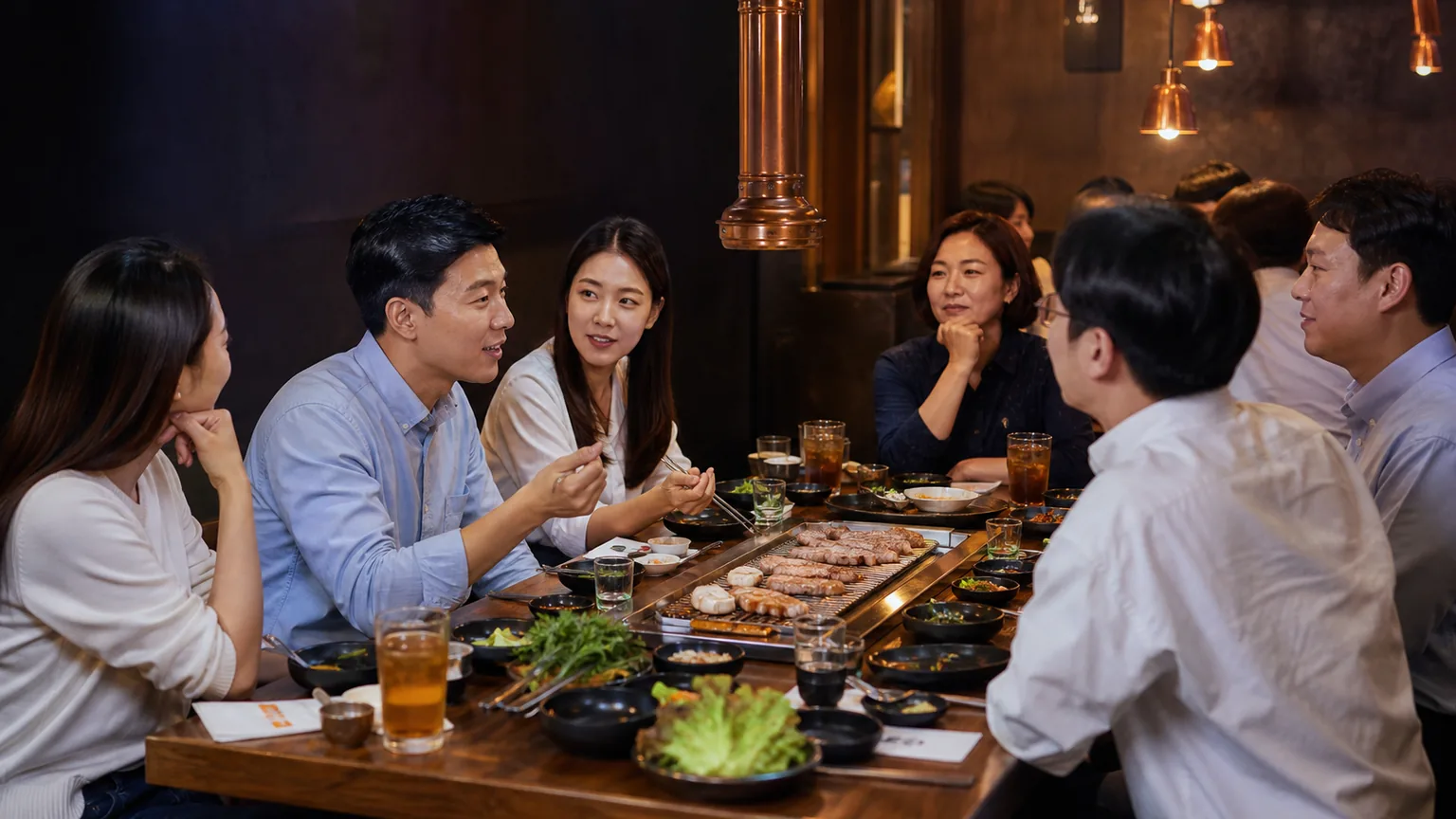
Korea.net’s account of workplace life and hoesik gives cultural context, while its official Discoveries of Korea guide provides a broader reference for Korean social customs. Individual workplaces still vary, so use the practical guidance below as a flexible framework.
Korean work culture · practical guide
How to join a Korean work dinner with curiosity, clear boundaries, and enough cultural context to feel at ease.
A Korean company dinner, or hoesik (회식), is less a single ritual than a shared social space after work. It can be a lively barbecue meal, a quick team lunch, or an informal chance to speak with colleagues away from the office. The most useful approach for a newcomer is not to memorize rules—it is to read the room, be considerate, and remember that participation does not require drinking alcohol or staying until the final round.
What a hoesik is—and what it is not
Until fairly recently—within the past 10 to 15 years in many workplaces—company dinners could feel more hierarchical: a manager’s invitation was often difficult to decline, and the gathering was commonly understood as a place to drink and unwind after work. That picture is changing, though not uniformly. Many teams now choose lighter meals, lunch gatherings, or coffee and tea meetings; some also use activity-based occasions such as an exhibition, a film, or a sports event. Younger workers in particular are helping move workplace socializing away from late-night, alcohol-centered occasions and toward formats with clearer choice and more varied ways to connect.
Hoesik literally means a company meal or gathering. It often brings a team together after a project, at the end of a busy period, or simply because a manager wants to thank everyone. Food is central: Korean barbecue, chicken, sashimi, stew, and shared side dishes are common choices. The Korea Tourism Organization describes the classic after-work format as moving from a filling first meal to optional later stops, but that is a familiar pattern, not an obligation every workplace follows.
The important distinction is between an invitation and a test. In a healthy workplace, a dinner is an opportunity to build rapport, not proof of loyalty. Teams differ by industry, age, manager, and company policy. Some start-ups prefer a short meal; some teams plan lunch instead; some coworkers do not drink at all. Treat the evening as a chance to get to know people, not as a performance of Korean-ness.
The best etiquette is simple: be present in the way you comfortably can, and give colleagues the same room to choose.
Before you go: make the easy choices early
If you have a dietary requirement, a religious restriction, or an early commitment, say so plainly before the dinner. A short, friendly message is enough: “I’d love to join for dinner, but I don’t drink,” or “I can stay until 9 p.m.” Clear notice makes it easier for the organizer to choose a suitable place and prevents an awkward explanation at the table.
When you arrive, follow the host’s lead on seating and ordering. Shared dishes are common, so it is normal to wait until food reaches the table before serving yourself. If meat is grilled at the table, someone may take charge of turning and cutting it; you can offer help, but there is no need to take over. The aim is to contribute without making the meal feel like a set of exams.
Drinking: participation is not a measure of respect
Alcohol can appear at some hoesik gatherings, often alongside food rather than as the whole purpose of the evening. Soju, beer, and a beer-and-soju mix called somaek are familiar choices, but none is mandatory. You can join a toast with sparkling water, soda, tea, or any drink you prefer. A quiet “I don’t drink, but cheers” is clear and courteous.
Older etiquette guides sometimes focus on pouring with two hands or turning slightly away from a senior colleague while taking a drink. These gestures can still be appreciated in formal settings, yet they should never override comfort, health, faith, or consent. If someone offers alcohol after you have declined, repeat your preference calmly. Most of the time, moving the conversation back to food or work is enough.
A useful rule for everyone at the table is this: do not pressure another person to drink, explain a personal choice, or continue past the time they said they need to leave. Good hospitality makes a guest feel included; it does not make them negotiate their boundaries.
Conversation that travels well
A company dinner often softens the formal rhythm of the office. Light questions about food, neighborhoods, hobbies, travel, or how someone found their field usually work well. Let coworkers set the level of personal detail. If conversation shifts to a topic you do not understand, asking “Could you tell me a little more about that?” is more inviting than pretending you follow every reference.
Be careful with topics that can put a colleague on the spot: salary, marriage plans, appearance, political loyalties, or why someone is not drinking. These subjects are not universally forbidden, but the difference between friendly curiosity and unwanted attention depends on trust. Newer colleagues will usually do best by listening first and matching the openness of the table.
Leave with a better definition of respect
It is easy to reduce Korean company dinners to a list of gestures: how to hold a glass, when to pour, whether to attend a second round. Those details can be useful, but they are not the heart of the event. The real skill is mutual consideration—thanking the organizer, noticing who may be left out of a conversation, respecting different appetites and drinking choices, and leaving without apology when you need to.
For a visitor or a new employee, that is good news. You do not need to become an expert in a single evening. Bring curiosity, ask questions, choose your own limits, and share the table generously. That is a far better foundation for workplace trust than any scripted rule.