Korean Vegetarian Food Beyond Bibimbap: A Guide to Namul
When I was growing up, a meat dish belonged to an occasion. A good report card, an entrance ceremony, a graduation, or a family birthday could bring it to the table; ordinary meals were more likely to revolve around vegetables. As a child, I complained about that arrangement and waited for the celebrations. Now, the foods I once tried to avoid—especially namul, seasoned vegetable side dishes—are among the things I miss most when a table feels incomplete.
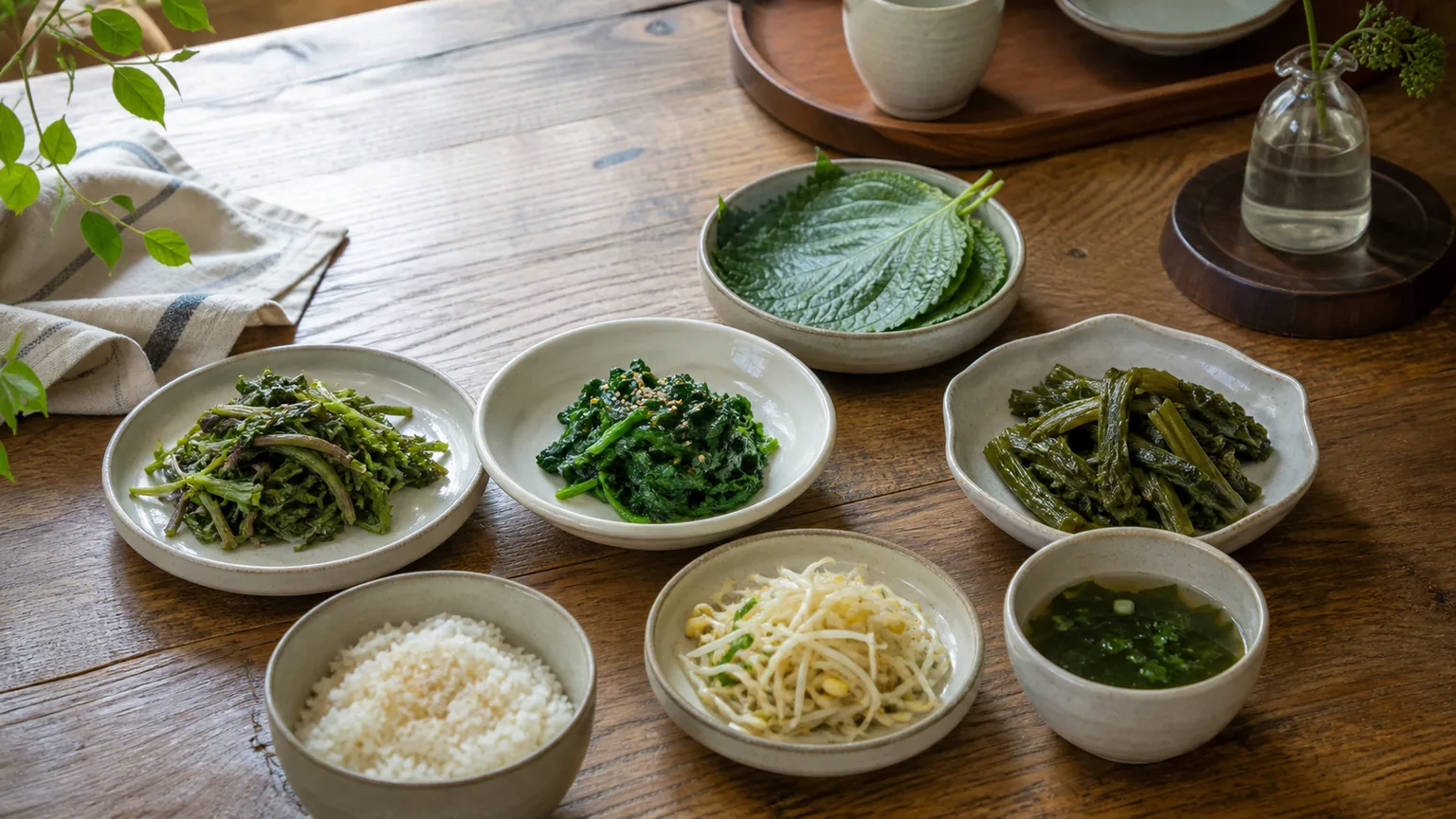
That is why bibimbap can be a slightly misleading introduction to Korean vegetarian food. It is a wonderful bowl, but it gathers everything together. A typical Korean meal often does the opposite: rice sits in the middle, while several small dishes let each vegetable keep its own scent, temperature, and texture. The pleasure is not just in eating more vegetables. It is in noticing how spinach, bean sprouts, bitter greens, perilla leaves, or roots change with blanching, seasoning, drying, and time of year.
Namul is a method, not one recipe
Namul usually refers to greens, shoots, or vegetables prepared simply—blanched and seasoned, stir-fried, or sometimes dried and later rehydrated. The same ingredient can taste entirely different depending on whether it is dressed with sesame oil, garlic, soy sauce, perilla seed powder, fermented soybean paste, or a little vinegar. This is less like building a salad and more like giving one ingredient a clear, limited stage.
Spring makes the idea especially easy to understand. The Rural Development Administration describes naengi (shepherd’s purse) as a representative early-spring ingredient, often used in soups or seasoned after blanching. Its guidance on naengi also notes that the leaves and roots can be handled separately when they differ in texture. That small act of adjustment is central to namul cooking: do not flatten an ingredient’s character; work with it.
Three gentle ways into a Korean vegetable table
1. Start with familiar greens
Spinach namul and bean-sprout namul are the easiest starting point at a Korean restaurant or grocery. They are mild, inexpensive, and familiar enough to make the seasoning legible. Eat each one with a spoonful of rice rather than piling every dish into one bite. You will notice that a sesame-oil spinach dish and a crisp, lightly seasoned sprout dish do different work on the same table.
2. Let spring taste sharper
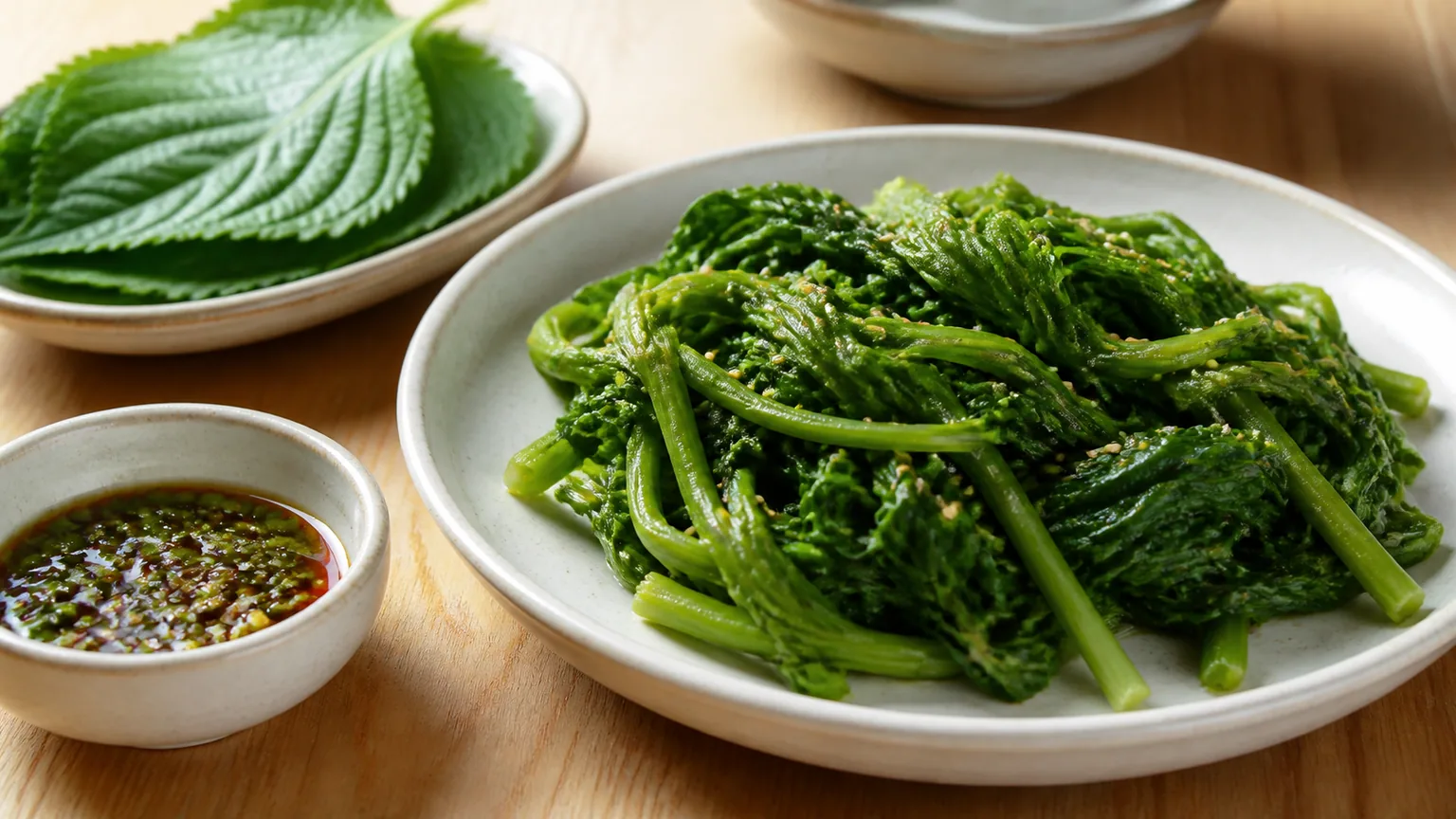
For a more seasonal step, look for naengi, dalrae (wild chives), chwinamul (aster greens), or dureup (tree shoots) in spring. Dalrae is often stirred into a soy-based sauce and spooned over warm rice; it has a pungent freshness closer to scallion than to a soft leaf. The Rural Development Administration’s food-culture archive traces dalrae preparations in twentieth-century Korean cookbooks, including a preserved and seasoned version that resembles today’s dalrae sauce. That history helps explain why the ingredient feels at home in a modest rice meal as well as in a seasonal menu.
Not every spring green is meant to be sampled raw. Korea’s Food Safety portal distinguishes greens such as dalrae and chamnamul that are often eaten fresh from ingredients including dureup and naengi that should be blanched before eating. Its preparation guidance is a useful reminder for visitors tempted to forage: buy identified produce and follow the normal preparation, rather than picking wild plants yourself.
3. Use a Korean grocery as a vocabulary lesson
Outside Korea, a Korean grocery is often the most practical place to begin. Fresh perilla leaves may be labelled kkaennip; in the United States, for example, H Mart lists them as fresh perilla leaves. Seeing the ingredient in a shop listing can be more useful than searching for a Western substitute. Dried chwinamul and bracken fern are also worth asking about, although they ask for soaking and a little patience. If the fresh selection is limited, spinach, bean sprouts, tofu, rice, sesame oil, and soy sauce can still make a convincing first table.
The question that makes a meal truly vegetarian
A table full of vegetables is not automatically vegetarian or vegan in Korea. Kimchi may contain salted seafood or fish sauce, and soups and sauces can begin with anchovy, seafood, or meat-based stock. At a restaurant, the most useful questions are direct: “Does this contain fish sauce or salted seafood?” “What is the soup stock made from?” and, if needed, “Could you leave out the egg?” Asking before ordering is more effective than assuming that a vegetable name guarantees a plant-based dish.
There is an etiquette point here, too. Korean meals are often shared, and staff may offer banchan without a long explanation. A calm request for one clearly vegetarian dish, or for the ingredients of a particular side dish, is easier for everyone than asking for a broad redesign of the whole table. If you are sharing, say your restriction at the beginning and keep any meat or seafood dishes separate from the rice and vegetables you plan to eat.
Eat the table one dish at a time
The most rewarding way to move beyond bibimbap is not to reject it; it is to slow down before mixing. Try one namul with rice, then another. Notice the nutty softness of sesame oil, the clean bite of a blanched green, the deeper flavor of a dried leaf that has been brought back with water and heat. Korean vegetable cooking has room for abundance, but its everyday elegance often comes from restraint.
For many Korean households, a vegetable-centered meal was once less a lifestyle label than a practical rhythm of ordinary days and occasional celebrations. That memory is personal, but the lesson is widely useful: a Korean vegetarian meal can begin with a bowl of rice and several small, distinct vegetables. Bibimbap is only one invitation to the table.