The AI Peninsula: Why South Korea is the New Frontier for Global Tech Investment
Discover how South Korea became the world’s 3rd leading AI power. Explore government strategy, semiconductor dominance, and prime investment opportunities in 2026.
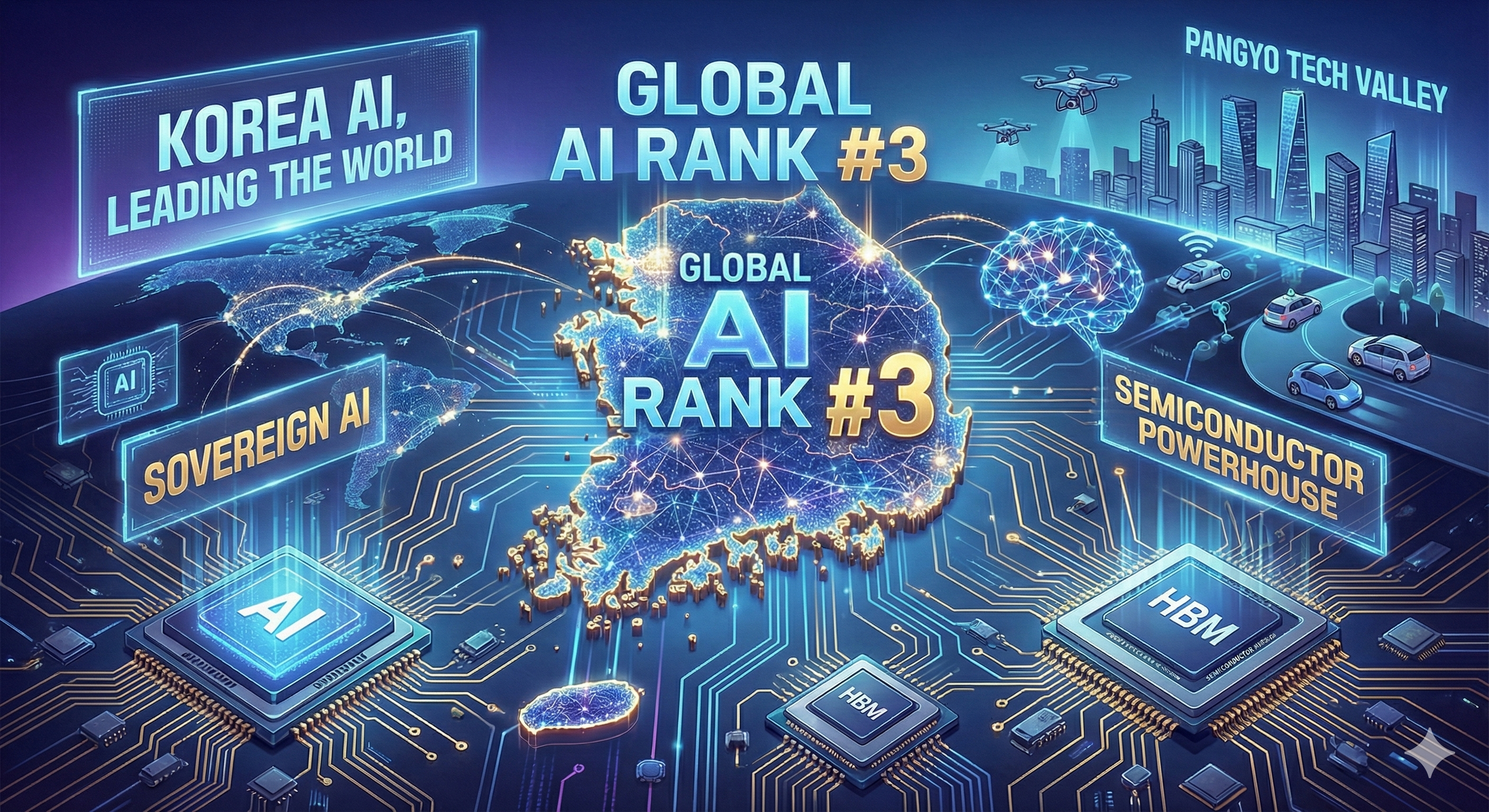
For decades, the global narrative surrounding Artificial Intelligence (AI) was a duopoly: the United States and China. However, as we move into 2026, a new titan has disrupted this balance. According to the latest Intelligence Index by Artificial Analysis (AA), South Korea has officially ascended to become the world’s 3rd leading nation in AI capability.
For international investors, tech analysts, and market strategists, this isn't just a regional success story—it’s a shift in the global center of gravity for innovation. South Korea has transitioned from a fast follower in the digital age to a frontier leader in the age of intelligence.
The Significance of the Artificial Analysis (AA) Ranking
Before diving into the "how," we must understand the "who." Artificial Analysis has emerged as the industry’s most rigorous benchmarking agency. Unlike traditional rankings that rely solely on venture capital volume or patent counts, the AA Intelligence Index utilizes a multidimensional framework that measures:
- Model Performance: Direct benchmarking of Large Language Models (LLMs) on reasoning, coding, and multilingualism.
- Infrastructure Readiness: The availability of high-end GPUs and domestic data center capacity.
- Economic Integration: How effectively AI is being deployed across manufacturing, healthcare, and finance.
South Korea’s leap to 3rd place—surpassing European tech hubs like France and the United Kingdom—signals that the nation possesses the "Full Stack" of AI: the chips to power it, the models to drive it, and the industrial base to monetize it.
South Korea's AI Power Matrix
South Korea’s ascent is no accident. It is the result of a synchronized "Triple Threat" strategy involving the state, the conglomerates (Chaebols), and a hyper-specialized startup ecosystem.
1. Semiconductor Leadership: The "AI Fuel"
You cannot have AI without silicon, and South Korea controls the world’s most critical AI hardware: High-Bandwidth Memory (HBM).
- SK hynix and Samsung Electronics currently command over 90% of the global HBM market.
- In early 2026, SK hynix began mass-producing HBM4, the essential fuel for NVIDIA’s next-generation Blackwell-series GPUs.
By controlling the hardware layer, Korea ensures its domestic AI researchers have "first-look" access to the world’s most powerful computing architectures.
2. The Rise of "Sovereign AI" Models
While the U.S. has GPT-4 and Claude, Korea has built its own "Sovereign AI"—models trained specifically on Korean linguistic nuances and cultural contexts.
- Naver’s HyperCLOVA X: A model that powers a massive ecosystem of search, shopping, and enterprise tools.
- LG’s EXAONE 3.5: Recently ranked in the top 20 globally by Artificial Analysis, proving that Korean models can compete on raw reasoning and scientific data processing.
- Upstage’s Solar Pro: A "compact but mighty" LLM that has outperformed larger models in efficiency, making it a favorite for on-device AI.
3. Pangyo Tech Valley: The "Silicon Valley of the East"
Located just south of Seoul, Pangyo Tech Valley has become the beating heart of the South Korea AI industry. In 2026, the completion of the "Second and Third Pangyo Valleys" has created a dense cluster of over 2,000 high-tech companies. This proximity allows for a unique "AI-to-Manufacturing" pipeline where startups can test their vision-AI algorithms directly on factory floors in nearby industrial hubs.
The Korean Government’s Ambitious AI Strategy: A 2026 Outlook
The most significant catalyst for Korea's 3rd-place ranking is the sheer scale of government backing. The Korea artificial intelligence policy is not just a white paper; it is a multi-billion dollar roadmap.
The "AI Highway" Initiative
In 2025-2026, the Ministry of Science and ICT launched the "AI Highway," a massive public-private partnership. Key components include:
- KRW 10 Trillion ($7.5 Billion) Budget: Directed toward next-generation R&D, specifically focused on "Physical AI" (AI for robotics and self-driving cars).
- GPU Democratization: The government has procured over 260,000 top-tier GPUs to be provided as a "public utility" for domestic startups and researchers.
- The AI Framework Act: Taking effect in January 2026, this is one of the world’s first comprehensive AI laws. Unlike the EU’s more restrictive approach, Korea’s law adopts an "innovation-first" philosophy, providing regulatory clarity that attracts foreign capital.
The Investor’s Perspective: Why Korea in 2026?
From a foreign investor’s lens, South Korea represents a "de-risked" entry into the Asian AI market. While other regions face geopolitical volatility or regulatory bottlenecks, Korea offers:
1. High-Value Exit Opportunities
The Korean IPO market is increasingly receptive to AI. Companies like Rebellions (AI chips) and Sualab (acquired by Cognex) have shown that Korean startups can achieve world-class valuations. The 2026 launch of the KRW 30 Trillion Public Growth Fund ensures that "Series B" and "Series C" startups have the liquidity to scale globally without leaving the domestic market.
2. A Ready-Made B2B Market
South Korea is the most automated nation on Earth (highest robot-to-worker ratio). This creates an immediate, high-paying B2B market for AI startups in South Korea. If you develop an AI for predictive maintenance, you have world-leading clients like Hyundai, Samsung, and POSCO waiting in your backyard.
3. Talent Density
South Korea consistently ranks at the top of the PISA and Bloomberg Innovation Indices for STEM education. The government’s new "AI-Centric University" program is currently churning out 10,000 specialized AI graduates annually, providing a deep pool of engineering talent at a lower cost-per-head than Silicon Valley.
Key Players to Watch
For those looking at global AI innovation, keep these entities on your radar:
| Sector | Key Player | Focus Area |
| Chips | SAPEON / Rebellions | Next-gen NPUs (Neural Processing Units) |
| Foundation Models | Upstage | LLM optimization and Document AI |
| Healthcare | Lunit / VUNO | AI-driven cancer diagnostics |
| Finance | Qraft Technologies | AI-managed ETFs and wealth tech |
A Future Forged in Intelligence
South Korea’s rise to the #3 spot in the Artificial Analysis AI ranking is a testament to what is possible when national ambition meets industrial prowess. The nation has successfully built a "Sovereign AI" ecosystem that serves as a blueprint for other mid-sized powers.
As we look toward the remainder of 2026, the "AI Peninsula" is no longer just a manufacturing hub for the world's gadgets; it is the laboratory for the world's intelligence. For the global investor, the message is clear: the next era of AI growth will not be written in English or Mandarin alone—it will have a significant Korean accent.