Why the Hyundai Motor Union Opposes Atlas Deployment
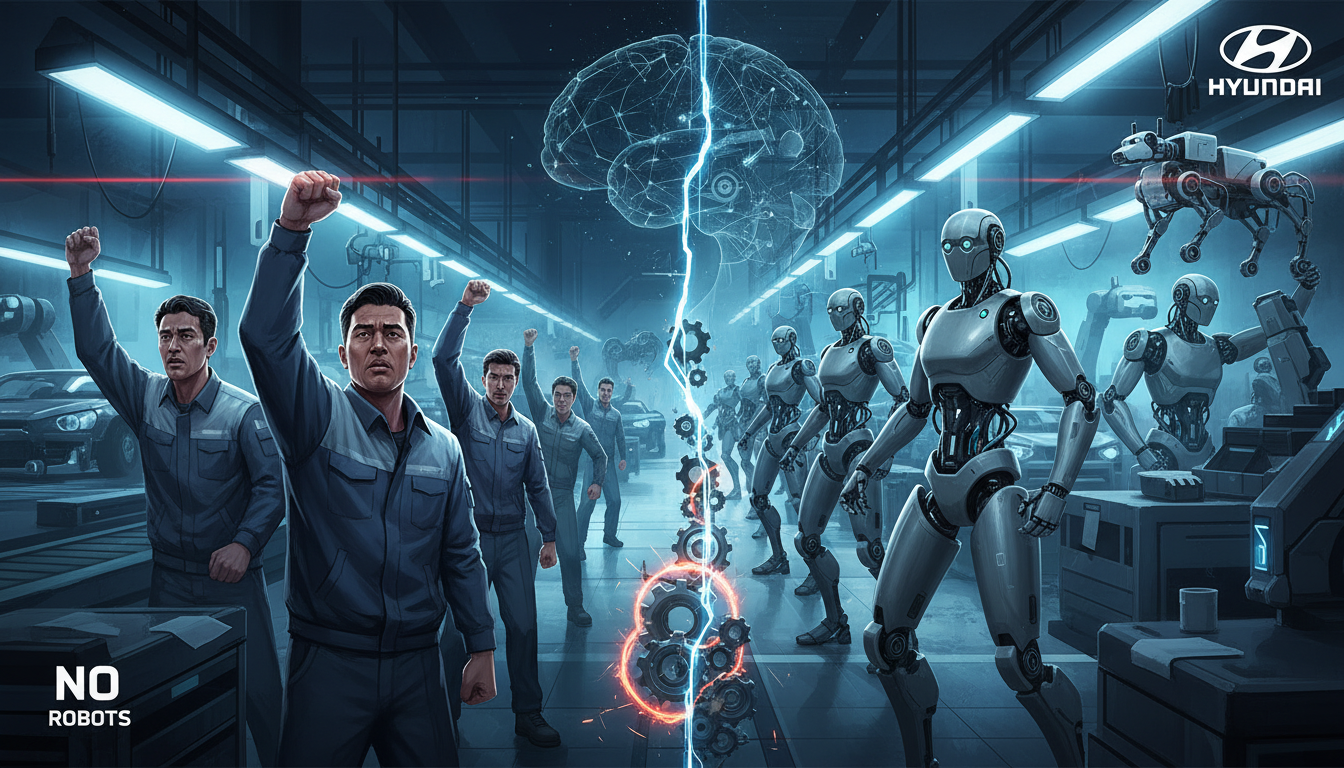
The hum of the modern factory is a symphony of automation, a sound that has long signaled progress. Yet, in the heart of South Korea's industrial landscape, a new note of discord is rising. The automotive world is captivated by advanced robotics, but a significant confrontation is brewing as the Hyundai Motor Union opposes Atlas deployment. This is not merely a local labor dispute; it is a profound examination of the very nexus between technological ambition and human anxiety. Here, we will delve into the complexities of why one of the planet's largest automakers faces a wall of resistance over its most sophisticated humanoid robots and what this moment portends for the future of labor itself.
Key Takeaways
- Hyundai Motor Group is set to integrate Boston Dynamics' Atlas humanoid robots into its factories, aiming to boost efficiency and assign safer tasks to its human workforce.
- The influential Hyundai Motor Union is staunchly against this move, declaring it will oppose Atlas deployment without a formal labor-management agreement due to fears of significant job displacement and "employment shocks."
- This standoff encapsulates a global dilemma: how to balance the undeniable economic advantages of advanced automation with the imperative for labor protection and the ethical integration of AI into our industrial fabric.
Understanding the Hyundai-Atlas Standoff
To grasp the current tension, one must understand the three central players: a corporation with a vision, a robot of remarkable capability, and a union with a powerful voice.
Hyundai Motor Group’s 2021 acquisition of Boston Dynamics was a clear statement of intent, a strategic pivot beyond automotive manufacturing toward becoming a "physical artificial intelligence corporation." This wasn't just about building cars more efficiently; it was about mastering the very mechanics of robotics and embedding advanced automation into the DNA of its manufacturing facilities.
The vehicle for this vision is Atlas, Boston Dynamics' fully electric humanoid robot unveiled in 2024. This is no mere mechanical arm. Atlas is a marvel of engineering, boasting 56 degrees of freedom, the ability to lift 110 pounds, and the intelligence to navigate factory floors autonomously, even swapping its own batteries for continuous operation. It is designed not for a cage, but for the complex, dynamic spaces of material handling, order fulfillment, and intricate assembly—tasks once the exclusive domain of human hands.
Against this technological push stands the Hyundai Motor Union. This is not an organization to be taken lightly. As one of South Korea's most formidable labor unions, it wields significant influence, rooted in a history of impactful protests. Its position is resolute: no Atlas deployment without a comprehensive labor-management agreement. The core concern is existential—the specter of mass job displacement. The union argues that while Hyundai builds machines, its true business still relies on human hands, and it fears the "employment shocks" that could ripple through its ranks as these advanced humanoids step onto the factory floor.
A Global Crossroads for Automation
This is not a theoretical, future-tense debate. The timeline is accelerating. At CES 2026, Hyundai announced plans to mass-produce 30,000 Atlas robots by 2028. Initial fleets are slated for deployment this year at its Robotics Metaplant Application Center (RMAC) and in collaboration with Google DeepMind. By 2028, they are expected to be operational in U.S. factories, including the Metaplant America in Georgia, starting with parts sequencing and eventually moving to assembly lines.
The union's response was swift. On January 22, 2026, it officially declared its opposition, drawing a clear battle line. Among the workers, a palpable unease has set in, a questioning of their own longevity in a world where their robotic counterparts never tire.
This drama is not playing out in a vacuum. It is a single, vivid scene in a much larger industrial play. BMW is already testing Figure 02 robots for detailed work at its Spartanburg factory. Mercedes-Benz is trialing Apptronik's Apollo for repetitive, physically demanding tasks. And Tesla continues to develop its Optimus robot, with Elon Musk's motivations appearing to be a mix of addressing labor shortages and, perhaps, a desire for a workforce that does not unionize. Hyundai's standoff is simply the most public and acute manifestation of a global trend.
From Industrial Arms to Humanoid AI
The journey to this moment has been one of strategic evolution. Hyundai's acquisition of Boston Dynamics for roughly $1.1 billion was the catalyst, a fusion of industrial-scale production expertise with pioneering robotics research. It signaled a long-term commitment to a future far beyond the traditional chassis.
Simultaneously, Atlas itself was maturing. It evolved from clunky, hydraulic-powered research prototypes into the sleek, fully electric, production-ready model that won "Best Robot" at CES 2026. This maturation was not just in hardware but in intelligence, with development focused on the dexterity and stability required for real-world application.
This represents a paradigm shift in factory automation. For decades, automotive manufacturing has been a proving ground for robots—large, powerful arms performing single, repetitive tasks like welding from behind safety cages. The move to humanoid robots is the next chapter. These are machines designed to be more versatile, to work alongside humans, and to perform a wider array of more complex, human-like tasks. They are not just tools; they are collaborators, competitors, and ultimately, replacements.
Innovation vs. Job Security
At the heart of this conflict lies a fundamental schism. The union foresees "employment shocks," where blue-collar roles—machinists, assemblers, welders—are systematically replaced. Hyundai, in contrast, promotes a vision of human-centered automation, where Atlas handles the "repetitive, heavy, and hazardous work," liberating human workers to ascend to "safer, higher-value roles" in supervision, training, and complex problem-solving.
The union decries this as a "one-sided decision without a labor-management agreement." This refusal to proceed without formal consent highlights a critical governance gap. How should societies navigate technological disruption? Through top-down corporate mandates or through negotiated, collaborative frameworks?
Beyond the economic calculus are deep ethical and psychological currents. For workers who have historically viewed robots as powerful but potentially dangerous caged machines, the presence of a 6.2-foot, 198-pound humanoid moving freely presents new anxieties. There is the fear of physical harm—past malfunctions at Volkswagen and Tesla serve as grim reminders—and the more subtle fear of intellectual displacement. What happens when over-reliance on robotic perfection leads to the deskilling of the human workforce? And when an error occurs, who is accountable—the programmer, the manufacturer, the AI itself? These are not simple questions.
Even the economic viability is debated. Some economists question if a complex, general-purpose humanoid robot is truly more cost-effective than a fleet of cheaper, specialized industrial robots. Yet, with the unit cost of humanoids projected to fall as low as $15,000, and their ability to work 24/7, the long-term productivity equation may prove irresistible, fundamentally transforming business models.
The Future of Work in a Robotic Era
Hyundai's roadmap is ambitious. After initial deployments in 2026 and a broader U.S. rollout for parts sequencing in 2028, the company aims to integrate Atlas into component assembly by 2030. This is part of an end-to-end AI robotics value chain, a seamless integration of Boston Dynamics' innovation with Hyundai's vast manufacturing and logistics network.
The intelligence powering this evolution will come from partnerships with AI giants like Google DeepMind. The Gemini AI model will enable Atlas to learn complex tasks with astonishing speed, adapting its behavior based on data from real production environments.
This inevitably leads to a transformed labor landscape. While job displacement is a real and pressing concern, it is also true that this wave of automation will create new roles: robot supervisors, maintenance technicians, AI trainers, and data analysts. The defining challenge will be whether we can create robust retraining and education systems to bridge the gap between the jobs lost and the jobs created.
Industry forecasts paint a startling picture, predicting 1.6 million humanoid robots in the automotive sector by 2035. The sci-fi concept of "dark factories," fully automated facilities running with minimal human oversight, could become a reality by the decade's end. For automakers, humanoids represent not just a way to cut labor costs, but a potential new revenue stream.
Frequently Asked Questions (FAQs)
- Q1: What is the main concern of the Hyundai Motor Union regarding Atlas robots?
- The union's primary concern is job displacement and "employment shocks" for its human workforce, fearing that humanoid robots will replace roles traditionally held by manual laborers.
- Q2: What exactly is the Boston Dynamics Atlas robot?
- Atlas is an advanced, fully electric humanoid robot developed by Boston Dynamics. It's designed for industrial tasks like material handling and assembly, featuring high dexterity, autonomy, and the ability to operate in diverse environments.
- Q3: Where does Hyundai plan to deploy these robots first?
- Hyundai plans initial deployments in 2026 at its Robotics Metaplant Application Center and Google DeepMind. Broader factory deployment will begin in 2028 at the Metaplant America in Georgia, starting with tasks like parts sequencing.
- Q4: Why does Hyundai Motor Group want to integrate Atlas robots into its factories?
- Hyundai aims to enhance productivity, improve worker safety by assigning robots to repetitive, heavy, and hazardous tasks, and transform into a "Physical AI" leader through advanced automation and human-robot collaboration.
The standoff between the Hyundai Motor Union and Hyundai Motor Group over the Atlas robot deployment is far more than a corporate dispute. It is a microcosm of the essential conversation of our time. As humanoid robots like Atlas, powered by sophisticated AI, push the boundaries of what is possible, we as a society must confront how to harness this immense potential for economic progress while protecting the dignity of human labor. The path forward requires not just technological innovation, but social and political innovation as well. The outcome in South Korea will not stay in South Korea; it will echo in factories and boardrooms around the world.