Your Essential Guide: 2026 Korean Trends You Should Know for the Year Ahead
Diving Deep into Korea's Dynamic Future
One cannot help but be captivated by the intricate tapestry of South Korea. It is a nation of profound paradoxes—a society hurtling toward an AI-driven future while simultaneously clutching at the analog and the authentic. As both an economic titan and a cultural epicenter, South Korea in 2026 stands at a fascinating crossroads, poised for shifts that will ripple across the globe. This guide is an attempt to look beyond the headlines, to uncover the 2026 Korean Trends you should know, and to ponder the deeper currents shaping this vibrant, complex nation.
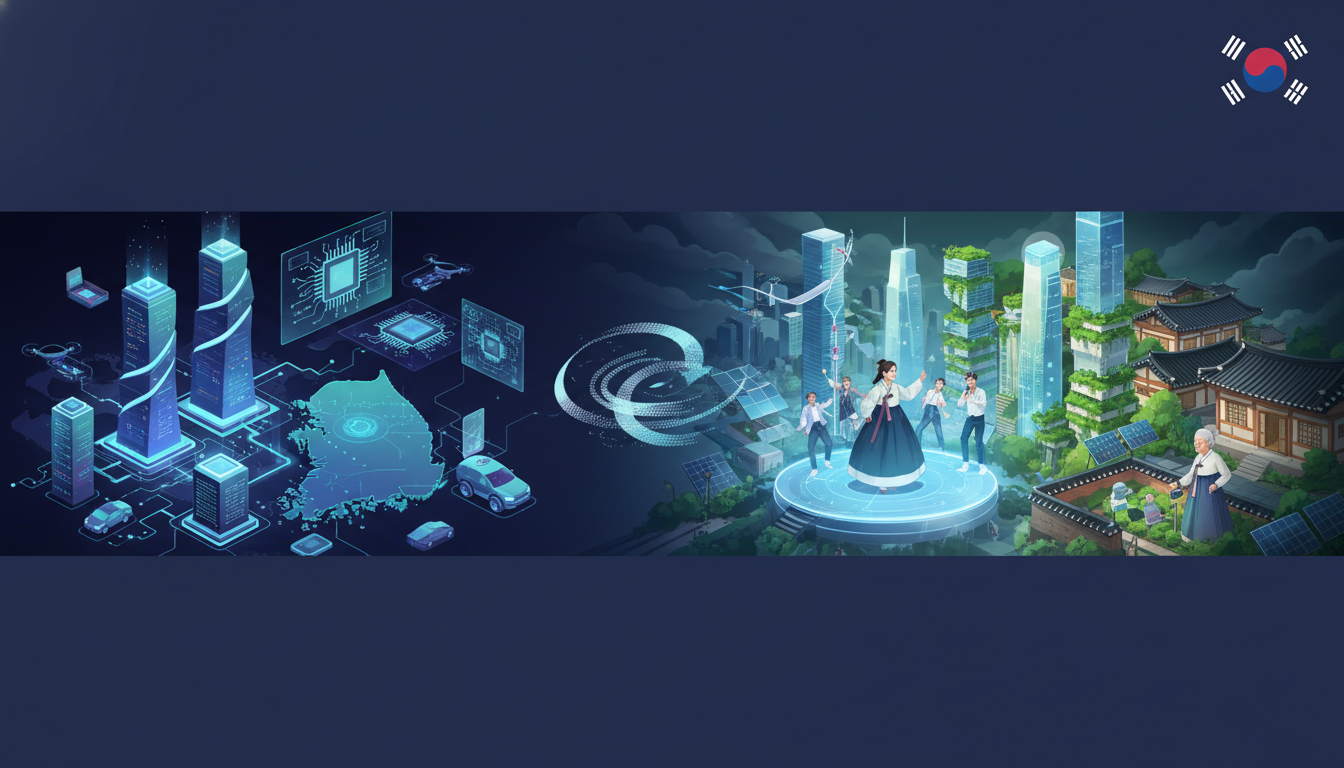
Key Takeaways:
- Tech Dominance & AI Integration: South Korea's strategic ambition to lead in AI, next-generation semiconductors, and 6G is more than an economic policy; it is a fundamental re-engineering of industry, society, and daily existence itself.
- Evolving Social Fabric: The nation is in the midst of a silent, profound reckoning with its own demographic destiny, giving rise to new household structures, a re-prioritization of holistic wellness, and a palpable yearning for authenticity in an age of digital saturation.
- Global Cultural Powerhouse: The "Korean Wave" or Hallyu, continues its relentless surge, cementing K-culture's global influence. Yet, this very modernity has sparked a curious "newtro" counter-movement—a nostalgic appreciation for traditional aesthetics and analog experiences.
South Korea in 2026 (An Overview)
To observe South Korea in 2026 is to witness a delicate balancing act. The nation navigates a landscape where economic resilience is juxtaposed with transformative pressures. The economy, after a period of turbulence, anticipates a moderate rebound, with GDP growth projected between 1.6% and 2.0%. This recovery is not broad-based but rather leans heavily on the formidable strength of its export engine, particularly in the ever-critical semiconductor sector. Government fiscal policy acts as a powerful undercurrent, injecting stimulus to catalyze this growth.
Yet, the true protagonist of this era is Artificial Intelligence. Identified as the most decisive consumer force for the year, AI is set to become an ambient, almost invisible, force, reshaping everything from industrial efficiency and supply chains to the very nature of consumer interaction.
Unpacking Current Korean Trends
South Korea often serves as a crucible for global trends, a place where the future arrives a little faster. The "age of AI transformation" is not a distant concept but a present reality. We see this in the push towards a "Zero Click" world, a fascinating paradigm where predictive systems anticipate our needs before we even articulate them. In the corporate sphere, the ideal of "Efficient Organizations Through AI" is giving rise to "liquid" and "agile" team structures, unbound by traditional hierarchies.
However, for every technological action, there is a human reaction. A powerful "human counterweight" is emerging. The rise of the "Feelconomy" suggests a shift in consumer logic, where purchasing decisions are driven less by utility and more by emotional resonance and psychological satisfaction. This is complemented by a growing focus on "Health Intelligence," a move beyond mere fitness to a proactive, holistic, and highly personalized vision of well-being. A deep-seated desire for "Returning to the Fundamentals" manifests in a preference for authenticity, craftsmanship, and tangible, analog experiences. Even the global phenomenon of K-beauty reflects this duality, embracing an "intelligent minimalism" where biotech advancements are used to achieve a look of natural, understated health.
The Evolution: Korea's Journey to 2026
To grasp the present, one must excavate the past. South Korea's modern identity was forged in the crucible of the post-war era. From the ashes of the Korean War, the nation engineered the "Miracle on the Han River," a period of staggering, export-oriented industrialization. This transformation, guided by aggressive government five-year plans and the rise of the powerful family-owned conglomerates known as chaebols (Samsung, Hyundai), cemented the nation's destiny as a high-tech powerhouse.
The roots of today's demographic anxieties also lie in this period. The very prosperity and effective family planning that signaled post-war success led to a precipitous decline in birth rates. This historical context is essential for understanding the immense challenge posed by today's aging population and the proliferation of single-person households. Culturally, while the bedrock of society was once the strict hierarchy of Confucian values, the dynamism of modern K-culture has erupted onto the world stage, a phenomenon in a constant state of self-reinvention.
What’s Next? Forecasting Future Developments in Korea
Looking beyond 2026, several powerful currents will shape South Korea's destiny.
The Super-Aged Society
One cannot overstate the gravity of the demographic cliff. By 2026, South Korea will officially be a "super-aged society," with over 20% of its population aged 65 or older. Projections suggest it will surpass Japan as the world's most aged population by 2045. The consequences are stark: a shrinking tax base and workforce will struggle to support a ballooning elderly population, straining social welfare and risking persistent fiscal deficits and falling per capita GDP. This demographic winter will be felt everywhere, from widespread school closures to a national security crisis as the pool of young men eligible for military service dwindles.
AI Transformation and Technological Leap
The "age of AI transformation" will only accelerate. The ambition is breathtaking. The K-Semiconductor Belt initiative aims to produce cutting-edge 2nm chips by 2026, ensuring continued dominance. The push for 6G connectivity, targeting speeds of 1 Tbps by 2025, is not just about faster downloads; it is about enabling a future of holographic communications and truly integrated smart cities. This technological momentum is also being channeled into a green future. A firm commitment to carbon neutrality by 2050 is driving innovation in solid-state EV batteries (targeted for 2025), green hydrogen production, and advanced solar technologies, creating new pillars for its export-driven economy.
Economic Diversification & Global Navigation
Pragmatism dictates that over-reliance on semiconductors is a strategic vulnerability. The next decade will likely see a concerted effort to diversify into adjacent high-tech fields like quantum computing and AI software. Domestically, managing the nation's high levels of household debt and stabilizing the real estate market will be paramount for long-term economic health. On the world stage, South Korea will continue its delicate geopolitical dance: consolidating its alliance with the United States, carefully engaging with its largest trading partner, China, managing the unpredictable threat from North Korea, and diversifying its global partnerships to build more resilient supply chains.
Quick Answers to Your Questions
Q1: What are the key economic predictions for South Korea in 2026?
A1: South Korea's economy is projected for moderate recovery, with GDP growth of 1.6% to 2.0%, primarily driven by strong semiconductor exports and expansionary government fiscal policies aimed at stimulus and AI investment.
Q2: How will AI influence daily life and industries in Korea?
A2: AI is a transformative force, creating a "Zero Click" world where systems anticipate needs and fostering "Efficient Organizations Through AI" with flexible team structures. It's integrated across healthcare, education, and manufacturing, though a "Human in the Loop" approach continues to emphasize the importance of human judgment.
Q3: What significant social challenges is South Korea grappling with?
A3: The most pressing challenge is the ultra-low birth rate and rapidly aging population, leading to a "super-aged society" and significant strain on social welfare systems. Other concerns include high youth unemployment, wealth gaps, and social unrest.
Q4: Is K-culture still a major global trend in 2026?
A4: Absolutely. The "Korean Wave" (Hallyu) continues to propel South Korea's global popularity across music, films, dramas, and K-beauty, with government strategies to further develop cultural content as a core growth engine and attract more tourists.
Bridging Innovation and Heritage
To contemplate South Korea in 2026 is to contemplate a nation at the very edge of the future. It is a place that weaves hyper-advanced AI and technological ambition into a cultural fabric rich with heritage and a deep-seated humanism. From the existential challenge of its demographics to its leadership in global innovation, it offers a compelling, and perhaps cautionary, glimpse into a future where the resilience of the past must constantly negotiate with the relentless pull of tomorrow.