K-Pop Demon Hunters and the Quiet Drama of Naksan’s City Wall
Use a global screen-culture prompt to find something older and more durable: the line of stone that still explains Seoul’s shape.
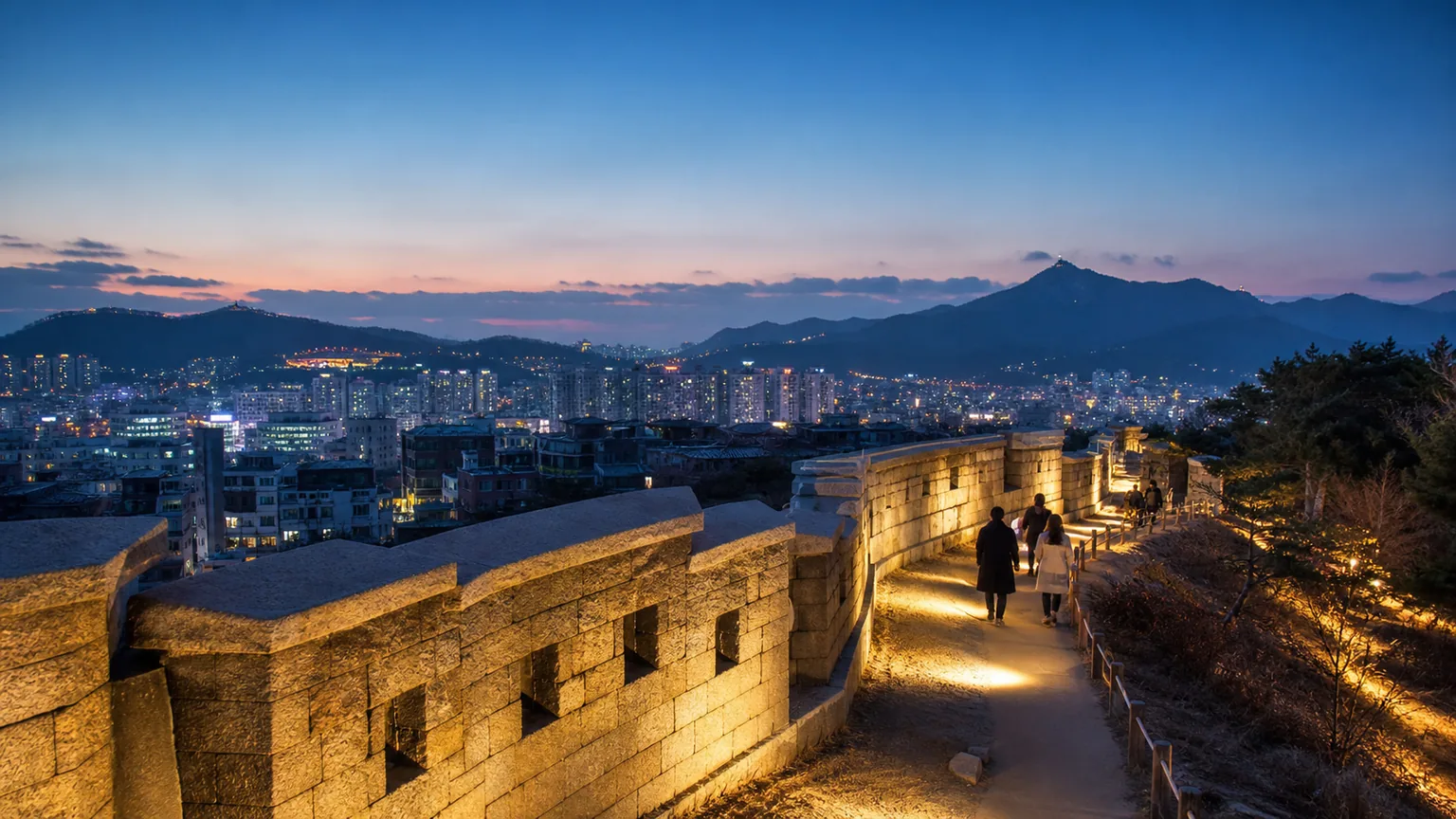
K-Pop Demon Hunters is still a useful doorway into Seoul for overseas readers. The important correction is that a real visit need not become a hunt for exact frames. On Naksan, the reward is a slower encounter with the Seoul City Wall: a ridge walk where the city looks both contemporary and deliberately historic. The film-led curiosity gets you there; the wall gives you the context.
A current UK travel feature treats Seoul’s blend of neon streets, palaces and mountains as a reason the city remains in overseas conversation. On the Korea side, the Seoul Metropolitan Government’s Naksanseonggwak-gil guide identifies a nearby K-Pop Demon Hunters photo point while mapping a much larger route through Naksan Park, Ihwa Mural Village and the Seoul City Wall Museum. That distinction matters. A visitor should not confuse an animation reference with an official set, or turn a residential hillside into a theme park.
Begin with the real place, not an imagined set
The city guide’s route runs from Hyehwamun Gate via Hansung University Station Exit 4 and the wooded stairs behind the Catholic University of Korea, then through Jangsu Village, Naksan Park Norimadang, the summit, Ihwa Mural Village and down toward Heunginjimun. It is a route description, not a promise that every section is effortless. Wear shoes with grip, carry water in warm weather, and choose daylight if this is your first visit.
Why a wall still matters in a skyscraper city
The Seoul City Wall, or Hanyangdoseong, was built to define and defend the Joseon capital. Its surviving stretches do not create one uninterrupted theme-park circuit; they pass through parks, neighborhoods, gates and reconstructed pieces. That unevenness is the point. The wall is not an isolated monument. It shows how Seoul has repeatedly made room for layers of civic life rather than clearing every earlier line from the city.
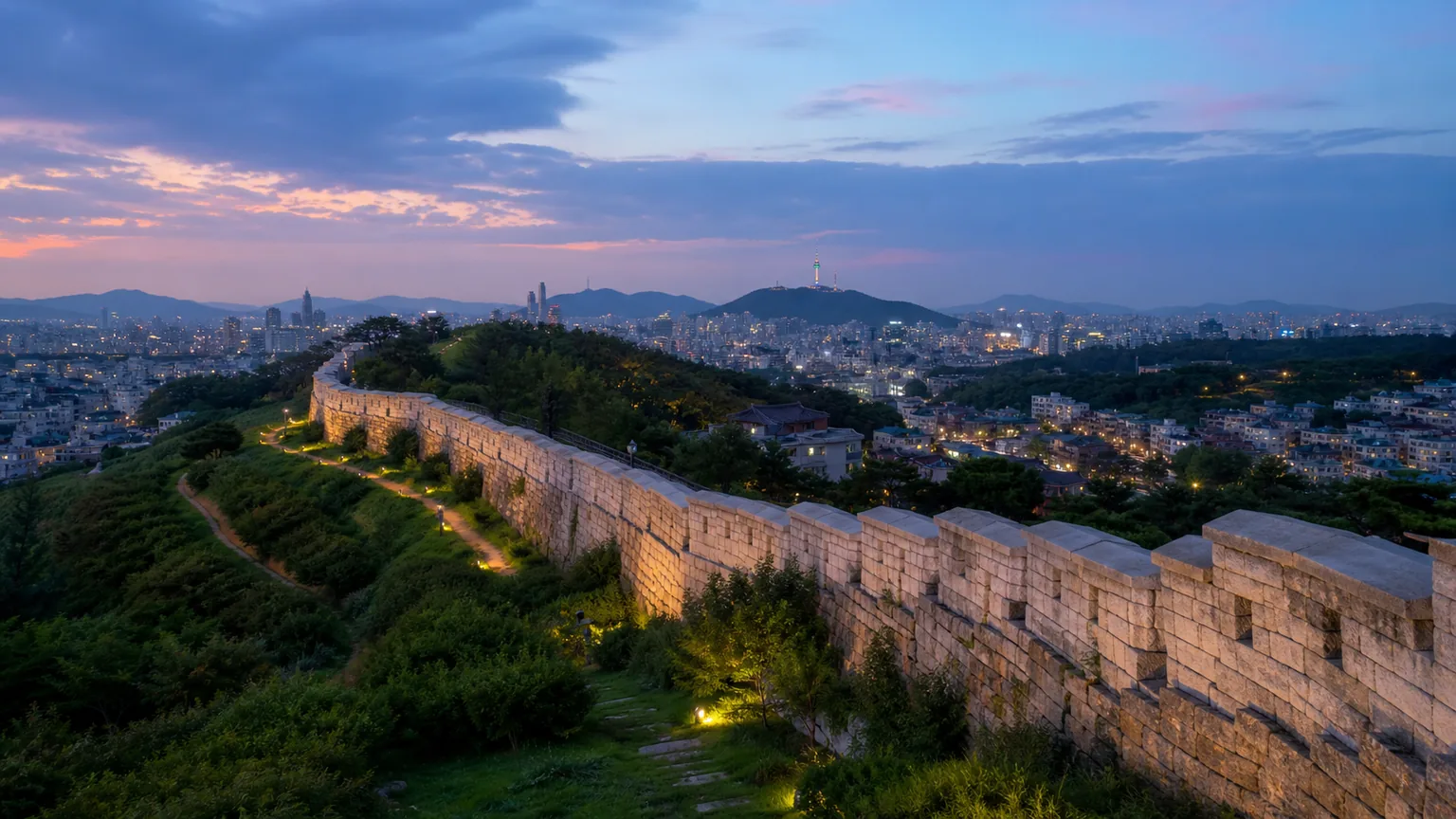
Naksan is particularly good for noticing this because the slope keeps the view moving. At one turn you see the patterned stonework and a quiet path; at another you see apartment blocks and the downtown skyline. The official guide notes the Naksan summit is 124 metres high and describes the outer route’s small ammun, or hidden gates. You do not need to treat every gate as a collectible. Pause long enough to understand its practical logic: walls controlled movement, and the ridge made both defense and communication possible.
The best screen-inspired itinerary does not demand that Seoul resemble a still image. It lets a real city keep its own scale, residents and history.
Make the walk a compact evening, not an endurance test
Start by deciding whether your priority is the wall, the view or the nearby mural alleys. Trying to complete every named stop at speed is a common visitor error because the elevation, stairways and summer heat add up. A better first plan is sixty to ninety minutes: begin at Hansung University Station, take the ascent gently, spend time at Naksan Park’s wall section, then decide whether you have the energy to continue toward Ihwa Mural Village. If it is humid, turn back before you are exhausted; Seoul has plenty of good second walks.
The route has no ticketed attraction at its center, so the practical planning is simple but important. Check daylight and rain before leaving, keep your phone charged, and use a map app to confirm the next access point rather than trusting a single social-media pin. The city guide explicitly frames Naksan as a nightscape attraction, but a dark, unfamiliar slope is not the right place to prove how adventurous you are. At dusk, follow maintained paths, stay with your group, and use public transit for the return.
What K-Pop Demon Hunters can teach without becoming the whole story
The interest is understandable. The film has encouraged viewers to notice Seoul locations and cultural textures that are often flattened into a generic backdrop. Seoul itself has used the phenomenon to introduce heritage programming: its 2025 cultural notice connected the film’s playful animal imagery with Bukcheong Saja Noreum, a nationally designated lion-mask dance, and with traditional martial-arts demonstrations at the historic Uijeongbu site. Those were dated events, not a standing promise for a 2026 trip. The useful takeaway is broader: Korean popular culture often works by layering a contemporary hook over older visual languages.
On Naksan, the layer worth attending to is the relationship between city wall, hill and neighborhood. It explains why a single viewpoint can feel cinematic without needing to be staged. Look at the wall’s curve, the narrow stairways and the way the city spreads below. Then let the film reference go. You will leave with a stronger sense of Seoul than any exact recreation could give you.
That approach also protects the pleasure of discovery. If you arrive expecting a location to look identical to a frame, construction, foliage, weather and a different camera lens can make the real place seem disappointing. If you arrive asking what the wall was built to do, how the hill changes the view, and how the route joins ordinary neighborhoods, the differences become information. This is the more generous way to use a cultural trend: it increases attention rather than narrowing it.
Consider pairing the walk with one nearby indoor stop only if it helps your group recover from the heat. The Seoul City Wall Museum is named on the official route, and the gate-and-wall landscape around Dongdaemun makes a natural continuation. Do not turn that option into an obligation. On a humid day, a shorter wall walk followed by transit to dinner is usually more memorable than forcing a heritage checklist into the same evening.
A low-stress Naksan rhythm
Before departure: check weather, daylight and your preferred transit exit. First 20 minutes: climb slowly and stop when the view opens; do not rush to a pin. Middle section: choose one wall stretch to photograph, then put the phone away. Finish: descend while you still have energy, or continue to Ihwa only if the group is comfortable with the stairs.
The etiquette question: a view is not private, and neither is a neighborhood a set
Naksan’s visual appeal makes considerate behavior unusually important. Do not climb, sit on or lean equipment against the historic wall. Keep clear of narrow passages and stair landings so residents, walkers and other visitors can pass. If you set up a tripod, make it brief and move when the path is busy. Drone flying, amplified music and costume shoots can change a quiet public walk into an intrusion; do not assume that a scenic image makes any of those activities appropriate.
The same care applies around homes and small businesses. Ihwa and the slopes around Naksan are lived-in areas, not a backdrop supplied for visitor content. Keep voices low after dark, avoid pointing a camera into windows or private yards, and do not block doorways while comparing map pins. If a sign asks for quiet or directs a route, treat it as part of the place’s hospitality rather than as an obstacle to an itinerary.
Photos are easiest when they are light on choreography. Take a quick landscape shot, include no stranger’s face as the subject without permission, and step out of the path afterward. If a local walker pauses behind you, the courteous move is to let them pass before completing the image. This is not only good manners; it changes the pace of the visit from extracting content to actually noticing where you are.
Leave room for the city beyond the trend
There is no need to dismiss K-Pop Demon Hunters to avoid shallow travel. A film can genuinely prompt an attentive visit, especially when it leads people to the Seoul City Wall and the old capital’s topography. But the responsible version of that visit begins with source-checked information, adapts to the weather and terrain, and respects the residents who make the hillside a real neighborhood.
For a first walk, Naksan offers a nearly perfect Seoul lesson: history is not sealed away, modern density is not the enemy of atmosphere, and a memorable view does not have to become a spectacle. Follow the wall at a humane pace and let the city be more complicated than the trend that introduced it.