Three Summer Festivals, Three Different Koreas
Boryeong, Incheon and the Hangang are all on the late-July calendar. They do not offer the same kind of trip, and treating them as interchangeable is the fastest way to plan the wrong weekend.
“Which Korean summer festival should I pick?” sounds like a calendar question. It is really a question about the kind of public life you want to step into. The Boryeong Mud Festival asks visitors to get involved physically; Incheon Pentaport is built around a concentrated music audience; the Hangang River Festival turns an already familiar Seoul landscape into a sequence of urban summer occasions. The dates overlap, but the social contract is different in each place.
This matters for a first trip to Korea because a festival listing usually gives equal weight to dates, tickets and headline attractions. It cannot tell you whether the outing works best as a two-night coastal break, a music-first weekend, or an evening folded into a Seoul itinerary. The comparison below uses the 2026 dates and descriptions published by the Korea Tourism Organization as a starting point; the judgment about fit is an editorial one, not an official ranking.
Start with the setting, not the headline
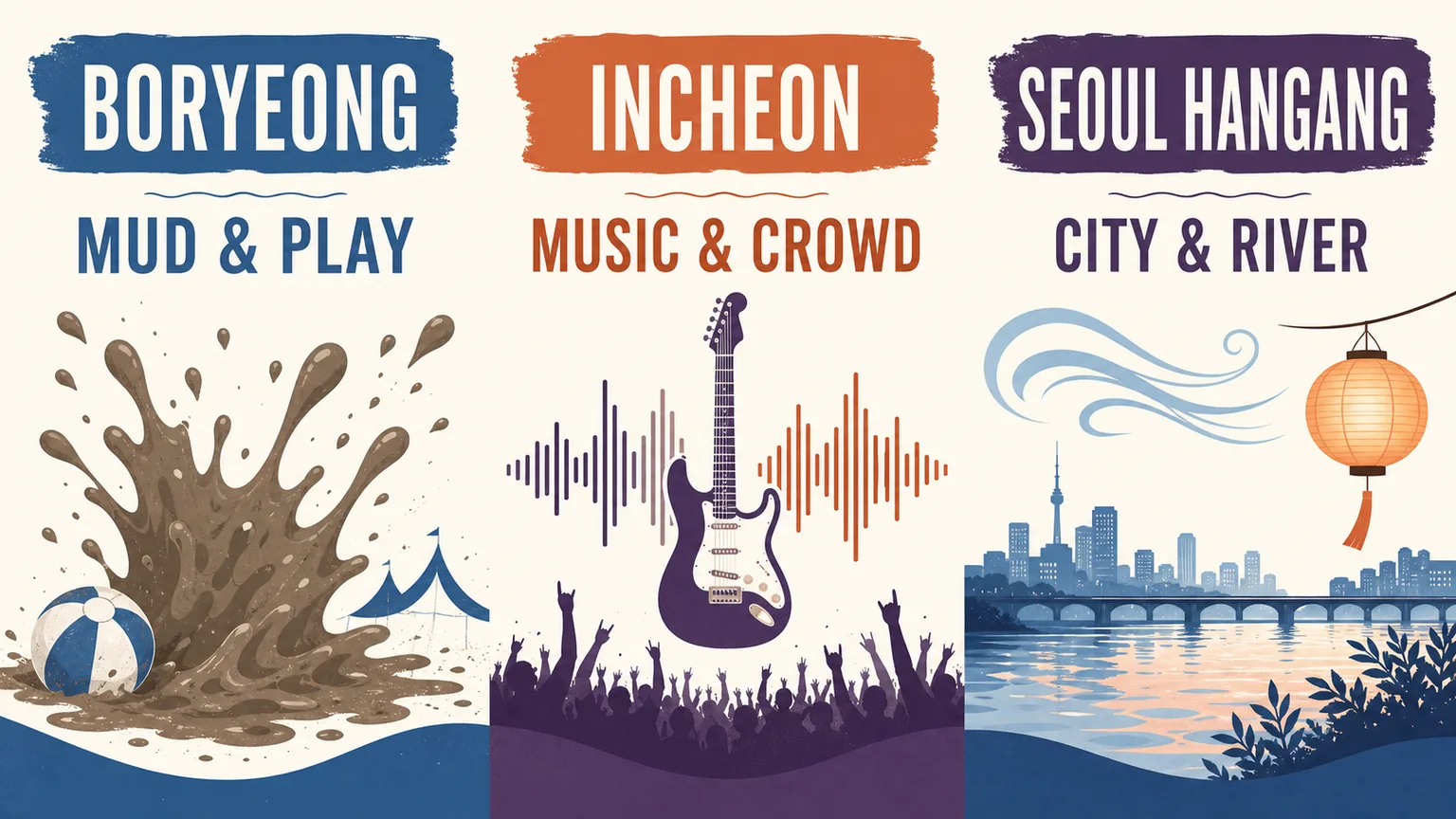
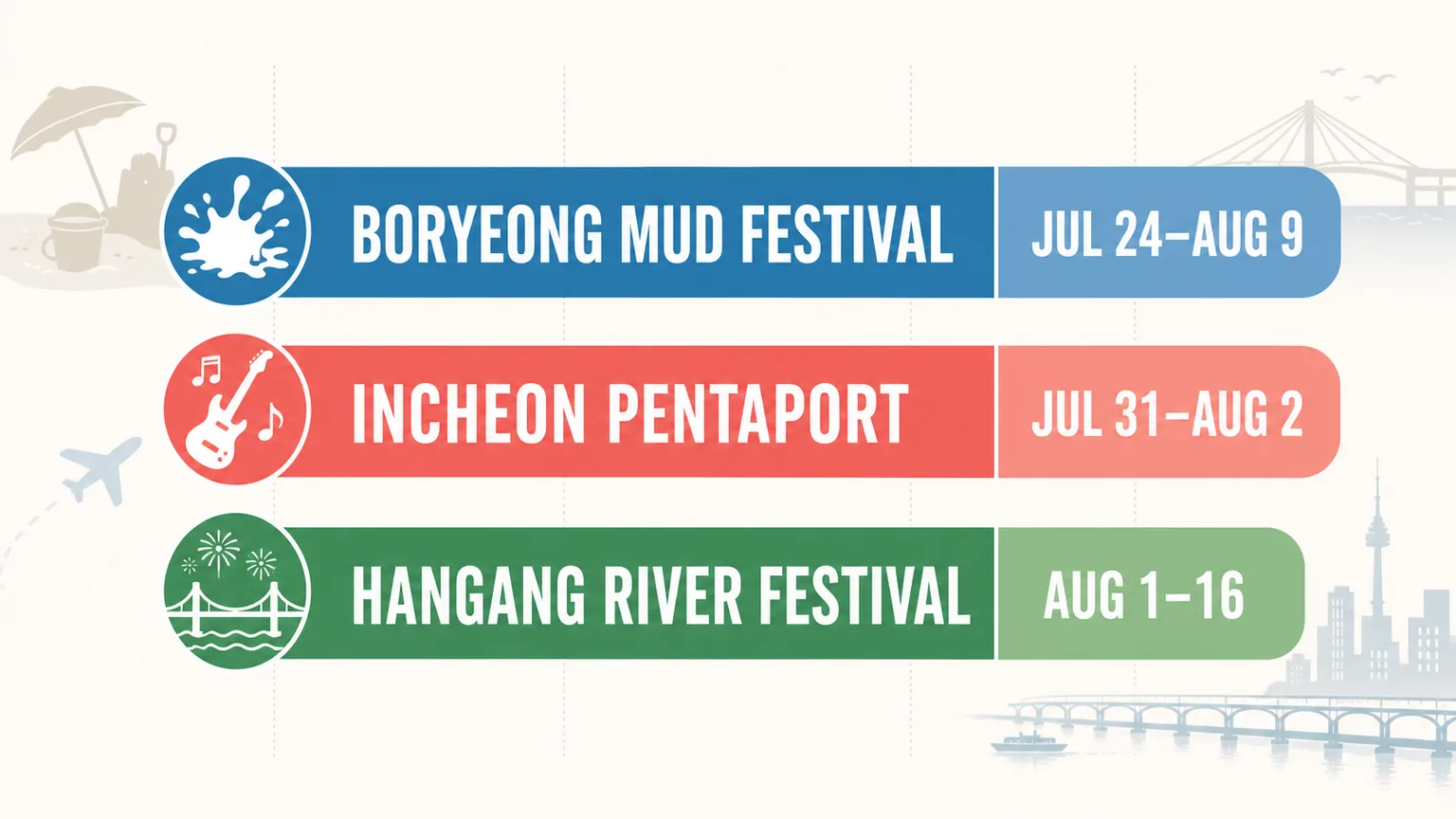
Boryeong belongs to the West Coast beach-trip tradition. The official tourism guide lists the 2026 Mud Festival from July 24 to August 9 at Daecheon Beach, framing it around hands-on mud activities. That is a very different proposition from looking at a stage for an hour and leaving. Clothes, footwear, a towel, waterproof protection for a phone, and tolerance for queues are part of the practical decision. The destination also asks you to give it more than an afternoon: the journey is worth treating as a regional coastal stay rather than a decorative add-on to Seoul.
Incheon Pentaport, running July 31–August 2 at Songdo Moonlight Festival Park according to the same official guide, concentrates its value into a music weekend. Its key question is not “do I like festivals?” but “am I willing to plan around a lineup, arrival time, crowd movement and return transport?” A visitor who wants a general Korean cultural experience can enjoy it, but someone who is indifferent to live music may be paying the logistical cost without receiving the central reward. Pentaport is about shared attention: the stage schedule and the crowd’s energy are the point.
The Hangang River Festival, listed for August 1–16 across Seoul’s major Hangang parks, works on another scale. The tourism guide describes water activities, outdoor films, concerts and water sports. Instead of requiring you to relocate your whole trip, it gives Seoul visitors a way to change the texture of an evening. That flexibility is not trivial. It makes the Hangang option better for a traveller who already has museum reservations, neighbourhood plans, or a short stay; it is less suited to someone looking for one immersive, all-consuming festival identity.
| Choose this when… | The strongest fit | What you are agreeing to |
|---|---|---|
| You want to join the activity, not observe it | Boryeong Mud Festival | Mess, beach logistics, a regional overnight plan, and a deliberately playful crowd. |
| Live music is the reason for the trip | Incheon Pentaport Rock Festival | Programme-dependent timing, sustained standing or crowd time, and a focused weekend. |
| You want a festival without leaving a Seoul itinerary behind | Hangang River Festival | A modular visit: you must still check which park and programme suit your evening. |
What “summer festival” means in each case
There is a useful Korean travel lesson hidden in the contrast. Summer programmes often turn a difficult season—heat, humidity and crowded leisure time—into a reason to gather outside. But they do so with different local materials. Boryeong makes a tidal-flat resource into an invitation to play. Pentaport uses a purpose-built festival setting to make music the shared language. Hangang programmes use a river that already functions as Seoul’s public escape valve, particularly when apartments and streets feel close in the heat.
That does not mean every visitor must search for a deep national meaning in a concert or a beach game. It means that the venue is carrying part of the message. At Boryeong, being prepared to look less polished is part of participation. At Pentaport, respecting the collective experience includes not treating the performance area as a photo backdrop. Along the Hangang, the more relevant skill is reading a large public park: find the specific programme, arrive with enough time, and do not assume that one park’s atmosphere represents the whole river.
What the Korean-language notices change for foreign visitors
To make the comparison more useful than an event calendar, I directly reviewed the official Korean-language announcements published by the organisers. The most important distinction is not simply what each festival offers, but how its entry system changes the day on the ground.
Incheon Pentaport Rock Festival: treat the phone as your ticket
According to Pentaport’s official 2026 ticketing and operations notice, paper tickets for delivery or on-site collection have been phased out. Entry is handled through mobile tickets and QR codes in the dedicated app. Foreign visitors should therefore use a designated global booking route that accepts international cards, such as Klook or an official global ticketing page, and make sure they can display the mobile pass at the gate. A working roaming plan or eSIM is not a luxury here: it is part of being able to enter.
Boryeong Mud Festival: online booking is not the only route
The 2026 operational guide states that advance online tickets are limited to 30% of daily capacity, while the remaining 70% are sold at on-site ticket booths. It also specifies a weekend facility-maintenance break from 1:30 to 2:30 p.m. If you intend to buy on site, arriving early is the sensible choice. If you pre-book online, bring the booking confirmation to the dedicated Online Reservation Exchange Booth to collect the physical entrance wristband before joining the activity area.
Hangang River Festival: the park is open, the programme may not be
Seoul’s official 2026 summer notices place major programmes—including Silent Disco, water sports such as kayaking and paddleboarding, and Nanji pool concerts under the Hangang Music Pongdang name—on limited-capacity advance reservation. General access to Hangang parks remains free, but that does not guarantee entry to a specific activity. Check the programme’s reservation page before building an evening around it; walk-in participation is generally not available for restricted-capacity sessions.
Build an itinerary around your energy, not around fear of missing out
The overlapping dates tempt people to stack everything into one week. That can work only if the trips are planned as different days, not as three versions of the same experience. Boryeong asks for recovery time after travel and beach activity. Pentaport rewards arriving before the part of the programme you care about, rather than chasing an entire day by default. Hangang can be an evening choice, but only after you identify a particular park and programme rather than treating “the river” as one venue.
Practical planning should remain modest about facts that change quickly. The Korea Tourism Organization advises visitors to check updates before travelling, and its 1330 Korea Travel Helpline is listed in the summer guide for traveller assistance. Confirm current transport, gates, paid options, weather controls and the exact park or beach directly with the relevant organiser. A precise plan built on stale information is less useful than a shorter plan with two verified checkpoints.
How to behave when the event is not “for tourists”
The etiquette issue common to all three is treating a public event as a shared environment rather than a personal content set. Do not block a path, viewing area, rental counter or beach access for repeated photos. Follow safety staff and designated swimming or entry controls. Keep music, picnic equipment and personal belongings within your group’s space. If a programme has a queue, a wristband rule or a restricted zone, do not expect an exception because you travelled far to attend it.
Those habits are useful precisely because each festival attracts different crowds. The etiquette is not about pretending to know every local custom; it is about noticing that the venue is being used by people who are not there to facilitate a visitor’s itinerary. The most respectful choice is often the least dramatic one: wait your turn, keep an exit clear, check a sign before crossing a barrier, and move on when a space is full.
The real choice is the kind of Korea you want to meet
These festivals are not a league table. Boryeong is the better choice when participation is the attraction. Pentaport is the better choice when music is the attraction. Hangang is the better choice when the city itself is the attraction. Once that is clear, the rest of the itinerary gets easier: you stop collecting names and start choosing an experience with an honest cost in time, energy and attention.