BTS’s Arirang Tour Points Back to a Living Korean Song
A global K-pop title is an invitation to listen more closely: not for a single “national anthem,” but for the many local voices gathered under one familiar word.
A current burst of overseas interest in BTS is a useful reminder that the word arirang does not begin and end with pop culture. BTS’s world-tour title has put it back in view; for a visitor in Korea, it can be a more rewarding prompt than a fan itinerary. Arirang is a way into how a song can be shared, altered, carried between regions and still feel recognisably Korean.
The timely hook is real but modest. Canada’s Google Trends page showed an active BTS-related query during this selection run; that is a reader-interest signal, not evidence about the music itself. The Korea-side fact is clearer: the Ministry of Culture, Sports and Tourism listed the BTS ARIRANG Busan performance at Busan Asiad Main Stadium. The larger story for visitors is why the tour title lands with such force in Korean ears.
Arirang is a family, not one fixed song
It is tempting to label Arirang “Korea’s folk song” and stop there. That shortcut is useful for a first introduction, but it hides the part that matters. The UNESCO inscription for Arirang describes a lyrical folk-song tradition with regional versions, shared refrains and lyrics that can change with the singer and setting. UNESCO added it to the Representative List of the Intangible Cultural Heritage of Humanity in 2012.
That flexibility is the point. A visitor may hear the familiar “Arirang, Arirang, Arariyo” refrain and assume every performance should lead to the same melody. In practice, Jeongseon Arirang, Jindo Arirang and Miryang Arirang carry different musical character, local history and pacing. They are related without being interchangeable. It is closer to a repertoire of homes than a single museum object.
That is also why a modern artist can borrow the name without claiming ownership of the tradition. The title can work as an association: separation and reunion, a road crossing, endurance, affection, a refrain that makes room for many verses. Interpretation belongs to the listener; the documented fact is that Arirang has long circulated as a participatory, variable folk tradition.
The most useful way to meet Arirang in Korea is not to hunt for one definitive version. It is to notice what each performance chooses to keep, slow down or make communal.
Go to a gugak performance, not just a photo spot
For a grounded encounter, put the National Gugak Center in Seocho-gu on a Seoul plan. Gugak means Korean traditional music, an umbrella that includes court music, folk repertories and instrument-led performance. The centre’s own performance pages are the reliable place to check programmes, ticketing and access before you travel; schedules change, so it is better not to build a trip around an old blog timetable.
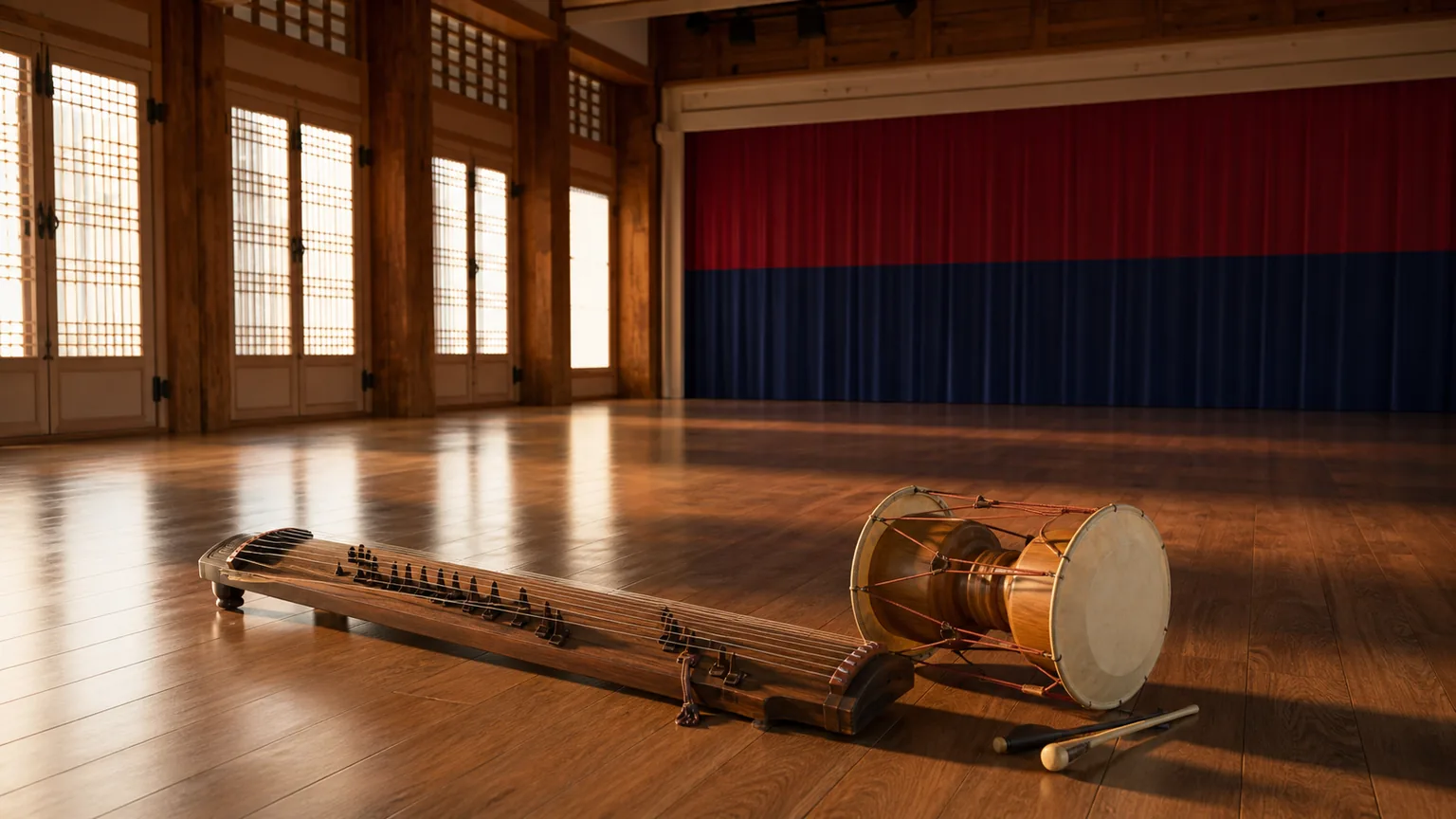
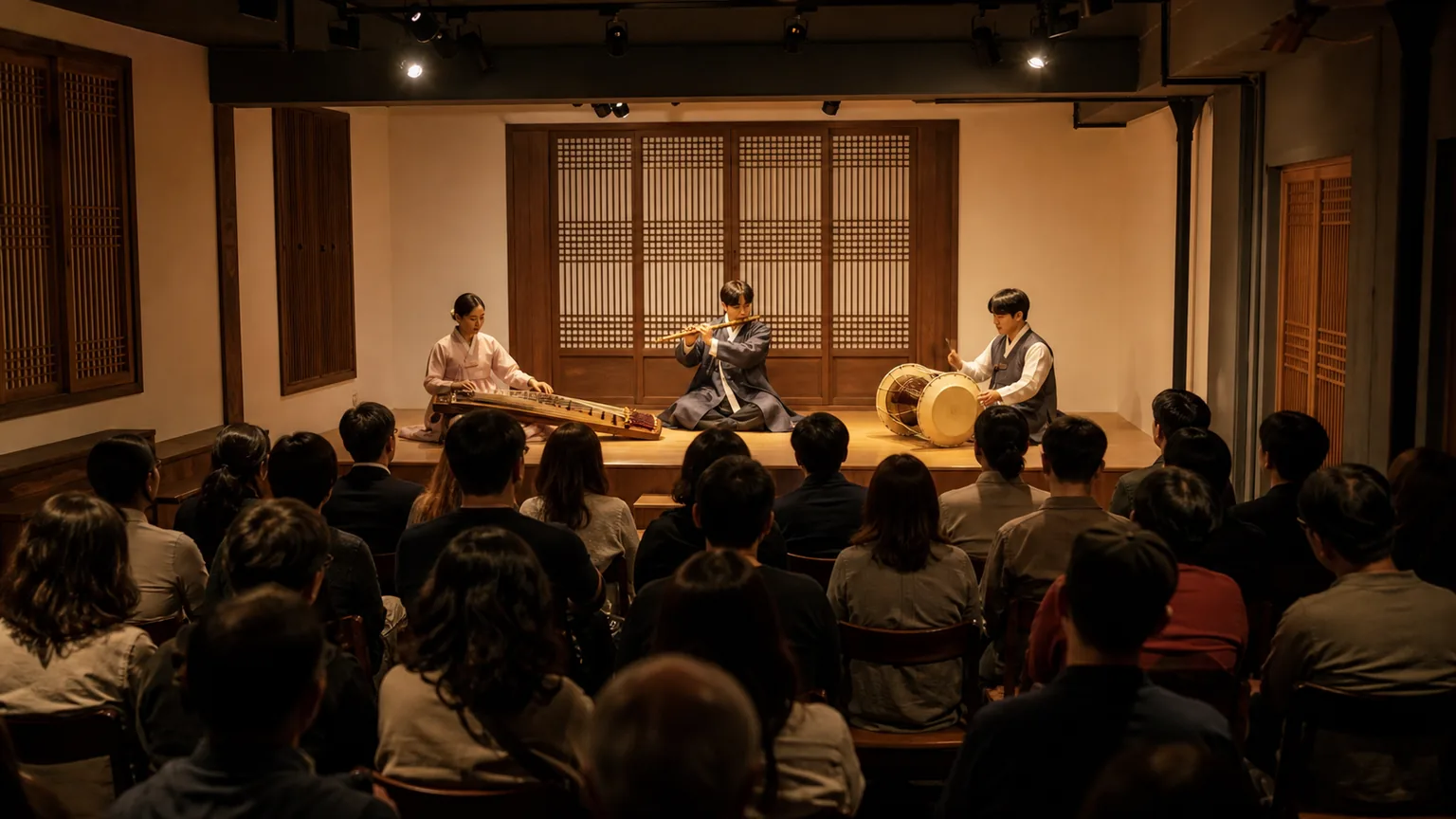
What you gain there is scale. A televised stage can make a tradition look ceremonial or remote. In a performance hall, the practical details do the explaining: the timbre of a gayageum zither, the breathy line of a bamboo flute, the physical pulse of a janggu hourglass drum, and the way a singer holds a phrase before the accompaniment answers. You do not need to identify every instrument to understand that Korean music often treats time as something stretched and negotiated, rather than simply filled.
There is a useful distinction here between access and expertise. You can buy a ticket, read a programme note and be an attentive listener without pretending to have mastered a tradition in an evening. For foreign visitors, that is a more honest goal than declaring one version “the authentic Arirang.” The experience becomes richer when curiosity stays specific: which instruments are in front of you, which phrases return, and what does this particular room ask of its audience?
If Seoul is not on your route, use the same principle elsewhere. Look for an institution, a local arts centre or an established festival that names performers and programme details clearly. Avoid booking a vague “traditional culture experience” that cannot tell you what will be performed. The fact that Arirang varies from place to place is not a reason to lower the evidence standard; it is a reason to value a programme that gives local context.
A compact plan that does not overpromise
Choose a programme listed by the venue, reserve only through its current official channel, and leave enough margin to arrive settled. Pair the performance with a quiet walk in nearby Seoul rather than trying to turn it into a checklist. If no Arirang appears on the bill, that is not a failure: a good gugak programme still gives the vocabulary to hear why a folk-song title carries cultural weight.
What to listen for
Do not turn the room into a fan-camera set
The easy mistake is to treat any traditional performance as background for a social post. A better default is simple: arrive before the start, silence the phone, keep photography to the venue’s stated policy, and follow the room’s cue for applause. If an unfamiliar passage feels quiet or suspended, waiting is respectful; applause does not need to fill every pause.
This is not a demand for stiffness. Korean audiences can be warm and responsive. It is a reminder that attentiveness is a form of participation. In a smaller hall, the performers can hear a ringtone, a whispered conversation and a camera shutter. Giving the music its space is the visitor behaviour that most reliably translates across venues.
One further courtesy is linguistic. If a title, lyric or announcement is not translated, do not interrupt the performance to ask a neighbour for a running explanation. Make a note and look it up afterwards, or ask venue staff during an interval if that feels appropriate. This preserves the shared concentration of the room and prevents a visitor’s understandable curiosity from becoming someone else’s obligation.
Why the title travels well
BTS is not a substitute for Arirang’s history, and a traditional concert is not a decoding key for a K-pop tour. Keeping those boundaries clear makes the connection more interesting. The tour title functions in a global cultural language; the folk tradition has a much longer, regionally rooted life. They meet at a word that many Koreans recognise before they agree on what it means.
That is the useful travel insight. Korea is often marketed as a series of clean breaks—palace versus pop, old versus new. Arirang is evidence that the more interesting line is often continuity with variation. A current global conversation can send you toward an older sound, and the older sound can change the way you hear the current one.
The practical takeaway is therefore modest. Use the BTS moment as a prompt, not a claim of cultural equivalence. Check a live gugak programme, choose one performance you can genuinely attend, and listen for the relationship between refrain, variation and audience attention. You will leave with something more durable than a title translation: a sense of how Korean music can keep a common form alive by allowing it to change.
That is also a useful correction to the idea that tradition is valuable only when it is frozen. Arirang’s cultural importance is not a license to reduce it to décor. Its continuing life comes from performers and communities making choices within a recognisable frame. Visitors do not need to resolve every historical layer to respect that fact; they simply need to let the music be more than a backdrop.