Beyond the Screen – AI Gets a Body!
We have become accustomed to conversing with artificial intelligence. We command it to write poetry, generate fantastical images, and debug complex code. This AI, for all its marvels, has been a disembodied mind, a ghost in the machine living behind our screens. But what happens when that mind is given a body? What happens when AI can not only think but also act upon the physical world with the same dexterity and nuance as we do?
This is not a question for science fiction; it is the central proposition of our time. Welcome to the era of "Physical AI," a paradigm shift where intelligence is embodied, and the digital finally learns to manipulate the atomic. Leading this profound transition is Hyundai, which, with its astonishing humanoid robot, ATLAS, has just shown us a tangible glimpse of the future. This is a moment that demands examination—a deep dive into the nature of Physical AI, the journey that brought ATLAS to life, the societal currents it has stirred, and the complex, fascinating path that lies ahead.

What Exactly is "Physical AI"? It's Smarter Than Your Smart Speaker!
One must resist the temptation to conflate this new wave with the familiar digital assistants in our homes. Physical AI, or embodied AI, represents a fundamentally different class of intelligence. It is not about mastering language; it is about mastering reality. This is an intelligence that sees through cameras, hears through microphones, and perhaps even feels through tactile sensors, constantly absorbing a rich stream of data from the world it inhabents.
Its defining characteristics are a departure from the scripted routines of old. We are speaking of an unprecedented level of autonomy, where a machine makes decisions in real-time based on the chaotic, unpredictable inputs of its environment. More profoundly, it possesses the capacity to learn and improve not through static datasets, but through continuous physical interaction—a process of trial, error, and refinement. This is intelligence forged in the crucible of the real world. We already see its nascent forms in self-driving cars navigating city streets, in warehouse robots that flow around human workers, and in the da Vinci systems that grant surgeons superhuman precision. But the humanoid robot is its ultimate expression.
A Quick Trip Down Robot Memory Lane: How We Got Here
The arrival of a machine like ATLAS was not a sudden event, but the culmination of a long intellectual and engineering journey. One can trace its lineage back to the dawn of Cybernetics in the mid-20th century, when thinkers first postulated that machines could learn and adapt through feedback loops. These were the conceptual seeds, which sprouted into the first lumbering industrial arms, performing simple, repetitive tasks with brute force.
The narrative gained momentum between the 1990s and 2010s. Robots began to gain "eyes" through the maturation of computer vision, and more importantly, they began to learn through reinforcement—the digital equivalent of trial and error. The idea that a robot could acquire skills by doing, by interacting with its environment, took firm hold. This led to the late 2010s, where "embodied AI" began to manifest in machines that could collaborate with, rather than simply replace, human workers.
The current decade, however, has witnessed an explosive acceleration. The advent of powerful simulation platforms, notably Nvidia's Omniverse, created digital playgrounds where AI could safely learn the laws of physics before ever touching a real object. Then came the generative AI revolution. The large language models that so captivated the world demonstrated how AI could achieve a nuanced understanding of abstract concepts. Physical AI represents the next logical step: taking that cognitive power and grounding it in a body that comprehends not just language, but space, mass, and causality. This intellectual fusion set the stage for CES 2025, where "Physical AI" became the defining buzzword. And now, at CES 2026, Hyundai has moved the conversation from theory to product.
Enter ATLAS: Hyundai's Humanoid Powerhouse
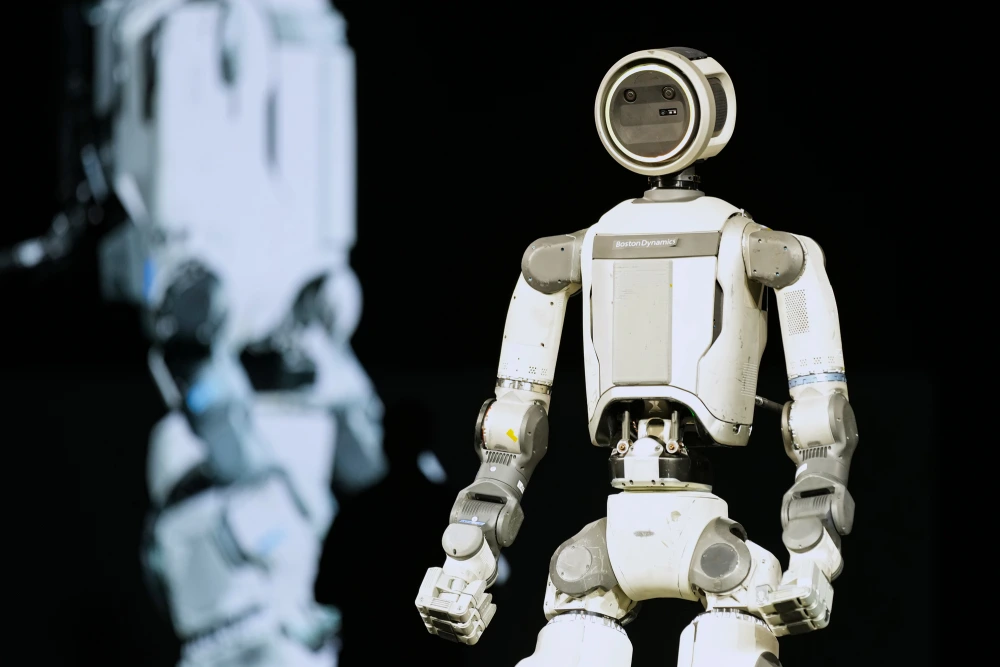
Unveiled at CES 2026, the new electric ATLAS is a statement. This is not another lab-bound prototype; it is presented as a product-ready machine. Having gestated within the visionary labs of Boston Dynamics, a company Hyundai had the foresight to acquire, this next-generation humanoid is a marvel of electromechanical engineering. It is a familiar form, now imbued with unprecedented power and intelligence.
To understand ATLAS is to appreciate the convergence of systems that allow it to function. It boasts 56 degrees of freedom, with fully rotational joints that grant it a range of motion exceeding that of a human. Its human-scale hands are not simple grippers; they possess tactile sensing, allowing for the delicate manipulation of objects. A 360-degree vision system provides a complete awareness of its surroundings, while its robust frame can lift 50 kg (110 lbs) and operate in temperatures ranging from a frigid -20 to a sweltering 40°C.
Yet, its most stunning attribute is its mind. The advanced AI at its core allows it to learn novel, complex tasks within a single day. It exhibits a remarkable degree of autonomy, navigating to its own charging station, swapping its battery, and resuming its work without human intervention. This is not just a tool; it is an independent agent.
V. The Robot Revolution is Now: ATLAS in Action
Hyundai's ambition is anything but modest. ATLAS is the vanguard of a comprehensive corporate strategy centered on physical AI. The company openly views humanoid robots not as a niche, but as the single largest segment of the future physical AI market.
The initial proving ground will be the factory floor. Beginning in 2028, fleets of ATLAS robots will be deployed in Hyundai's Metaplant in America, first handling the relatively simple task of sorting parts. By 2030, the plan is for them to graduate to complex assembly work. The rationale is clear: to delegate tasks that are dangerous, repetitive, and physically demanding, thereby creating manufacturing environments that are both safer and vastly more efficient.
This endeavor is not a solo act. Hyundai is forming a powerful triumvirate, partnering with AI titans like Google DeepMind and NVIDIA. The hardware of Boston Dynamics is being married to the most advanced software brains on the planet. This alliance speaks to the immense capital and potential at play. Market analysts project the humanoid robotics market could swell to trillions of dollars by 2050. With a target price of around $150,000 per unit by 2028 and an aim to mass-produce 30,000 units annually, Hyundai is positioning itself to define the market, not just enter it.
The Robot-Sized Questions: Controversies and Challenges
Such a profound technological shift does not arrive without stirring deep-seated anxieties and raising difficult questions. The most immediate and visceral of these is, "Are robots taking our jobs?" This is not mere Luddism, but a legitimate concern voiced by labor unions, such as Kia Corp's, who see expanding automation as a direct threat to human employment. Hyundai's counter-narrative is one of transformation, not replacement. They argue ATLAS is designed to make work safer, augmenting human capabilities and creating new, higher-skilled roles in robot maintenance, programming, and oversight. It posits a shift in the nature of work, an argument that history has borne out in previous industrial revolutions, but which offers little comfort to those whose skills may be rendered obsolete.
Beyond the economic, there are ethical quandaries. The same dexterity and problem-solving that make ATLAS adept at factory work—including demonstrated martial arts maneuvers—inevitably raise the specter of military applications. The dual-use nature of this technology is an uncomfortable truth we must confront. Furthermore, as we gaze toward a projected future of humanoids in our homes by 2035, we must grapple with issues of safety, privacy, and the very integration of autonomous, non-human agents into the fabric of our daily lives.
Then there are the immense real-world hurdles. An impressive stage demo is a world away from reliable, scaled performance in a dynamic environment. The leap from the lab to life is fraught with challenges. The "black box" problem of AI, where the reasoning behind a machine's decision is opaque even to its creators, becomes far more acute when that machine is operating heavy machinery. Accountability becomes a tangled web. Moreover, training physical AI is a slow, expensive process demanding vast quantities of real-world data, where failures are not just lines of code but potential physical damage. And for all their advancements, limitations in battery life, strength, and component durability remain significant engineering frontiers in a fierce competitive race against Tesla's Optimus, Amazon, BYD, and a dozen other contenders.
The Future is Now-ish: What's Next for ATLAS and Physical AI
Hyundai's roadmap is clear and aggressive. The goal of 30,000 ATLAS units annually by 2028 is just the beginning, with plans to expand across their global manufacturing network. To accelerate this, dedicated R&D centers are being established. The Robot Metaplant Application Center (RMAC), opening in the U.S. this year, will serve as a real-world training ground, a university for robots. Simultaneously, their partnership with Google DeepMind aims to use fleets of ATLAS robots for mass data collection, developing "general humanoids" with the ultimate goal of creating an AI that can adapt to virtually any environment or task.
The factory is only the first step. The long-term vision sees ATLAS deployed in logistics, energy, construction, and facility management. Eventually, the ambition is to cross the threshold into our homes, where they could function as integrated assistants. To facilitate this widespread adoption, Hyundai plans to introduce "Robotics-as-a-Service" (RaaS), a subscription model that would lower the barrier to entry for businesses, bundling the machine with maintenance and software updates.
The anticipated impact is nothing short of a new industrial revolution. It promises supercharged production cycles with fewer errors, workplaces free from human injury, and the evolution of the labor force toward high-tech roles in robotics and AI management. The economic ripple effects will be immense, signaling a fundamental reordering of industry and labor.
Our Robotic Co-Workers are Coming – Ready or Not!
Hyundai's ATLAS is more than an impressive piece of technology; it is a physical manifestation of a new epoch. It marks a tangible leap into the future of Physical AI, a future where intelligent machines will not only process information but will walk, work, and exist alongside us.
The excitement is palpable, and the potential for enhancing productivity, safety, and innovation is immense. Yet, this excitement must be tempered with caution and foresight. We cannot afford to ignore the vital conversations about the impact on labor, the ethical guardrails we must erect, and the slow, deliberate process of building societal trust in these autonomous systems.
The future, it seems, is not one of humans versus machines. Rather, it is one of a human-robot partnership. As ATLAS prepares to take its first steps onto the factory floor, it heralds a new chapter in our species' long history of tool-making. This time, however, the tool can think for itself. This new reality will demand of us a profound capacity for adaptation, thoughtful governance, and a willingness to redefine our relationship with the machines we create.


